
The Benefits of Reading Quran Daily: Building a Habit That Actually Sticks
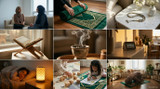
My grandmother read Quran every morning after Fajr, on the same cushion, in the same corner of the living room, with the same wooden stand that had gone slightly grey at the edges from years of hands touching it. I don't remember her ever announcing it. I just remember waking up early once, maybe eight years old, and hearing the specific sound of pages turning — not fast, not slow, just steady — before anything else in the house had started.
I tried to copy that for years and mostly failed. I'd read every day for a week and a half, feel proud of myself, and then miss one morning because I overslept, and somehow that one missed morning would turn into two weeks of nothing. Not because I stopped caring. Because the habit never had a shape. It lived in my head as an intention, not as a corner of a room or a specific object or a specific time.
Here's what actually makes it stick.
Why Daily Quran Reading Falls Apart By Week Two
Most people don't quit because they lose interest. They quit because the habit was never attached to anything physical. It existed as a mental note — "I should read more Quran" — floating somewhere next to "I should drink more water," easy to postpone because nothing in the environment was asking for it.
Compare that to salah. Salah has a time, a direction, a physical motion. It's hard to forget because the structure does half the remembering for you. Quran reading, for most adults, has none of that. The mushaf is in a drawer or a bag or wherever it landed last. There's no stand, so you end up hunched over it on your knees, and hunching over something for fifteen minutes is not a position your body wants to repeat daily. There's no fixed corner, so it competes with the couch, the phone, the fifteen other places your attention already lives.
The daily reading habit that survives is the one with a place. A stand that stays out. A light that's already on. A specific fifteen minutes that has a physical trigger — after Fajr, before the kids wake up, right when you sit down with your coffee. Once the object is there and the spot is there, the discipline stops doing all the work by itself.
A Stand So You're Not Balancing the Mushaf on Your Knees
This sounds like a small, almost embarrassing thing to fix first. It isn't.
Most people who try to build a daily reading habit are reading with the Quran flat on a bed, propped against a pillow, or balanced open-faced on crossed legs — and closing it after ten minutes has nothing to do with willpower and everything to do with discomfort. A stand changes the physical experience entirely. The Wooden Quran Stand has a cherrywood finish with ornate carving, folds flat for storage, and holds the mushaf open at an angle that actually invites you to sit and stay a while instead of finishing the page and closing it out of relief. Once it's out on a side table or a shelf, it becomes a visual cue on its own — you walk past it, and it reminds you before you've even thought about reading.
The Rehal That Makes the Corner Feel Like It's Meant For This
There's a difference between a stand that's functional and a stand that makes a corner of your home feel dedicated to something. My grandmother's corner worked because it didn't look like anywhere else in the house — it had its own gravity.
The Quran Holder Stand in Beech Wood, Inlaid with Mother of Pearl does that. It's a Rehal — the traditional folding X-shape design used for generations to keep the mushaf elevated and treated with the respect it deserves — and the pearl inlay is arranged in geometric and floral patterns that catch light differently depending on the time of day. It folds flat, so it's practical, but it doesn't read as "storage furniture." It reads as something built specifically to hold this one book. That distinction matters more than people expect. A dedicated object makes a habit feel less optional.
Tajweed You Can Actually Hear Yourself Get Wrong
A big, quiet reason adults avoid daily reading: they're embarrassed by their own tajweed. Nobody says this out loud, but it's real — reading slowly, mispronouncing a letter, not knowing if the elongation was right, feels exposing even when you're alone in a room.
The Digital Quran Read Pen with Tajweed removes some of that pressure. Touch the pen to any word or verse and it plays the recitation aloud from well-known Qaris, so you can follow along, repeat after it, and correct yourself without asking anyone or feeling like you're back in a classroom. It comes loaded with the Tajweed Qur'an, Norani Qaida, and texts like Hisn al-Muslim, plus multi-language translation for people who want to understand what they're reading, not just pronounce it correctly. For someone rebuilding the habit from a shaky starting point, that combination — correction plus comprehension — does more for consistency than motivation ever will.
Something Playing While You Cook, Drive, Fold Laundry
Not every day allows for fifteen still minutes on a cushion. Some days the only Quran that happens is what's playing in the background while you're doing something else with your hands, and that still counts. It still builds the habit of the recitation being present in your day, even in a smaller form.
The 3D Moon Quran Speaker Night Light is built for exactly that kind of low-effort consistency. It's a Bluetooth speaker shaped like a soft glowing crescent moon, controllable through an app or remote, and it streams recitation from your phone or plays from its own reciter library — eighteen well-known voices, including Sudais, Al-Ghamdi, and Mishary. Small enough to carry from the kitchen counter to the bedside table, it becomes the thing playing during the parts of the day that don't have room for a stand and a cushion, which for most people is most of the week.
The Mushaf That Comes With You
Consistency breaks the fastest when the mushaf never leaves the house. Waiting rooms, work breaks, the ten minutes before everyone else wakes up on a trip — those are real reading windows, but only if there's something small enough to carry.
The Velvet Mini Quran & Pearl Tasbeeh Gift Set Box is compact — about three by two inches, velvet-bound with gold foil detailing — and it comes packaged with a ninety-nine-bead pearl tasbeeh in the same box. It's easy to underestimate something this small, but it's exactly the kind of object that ends up in a bag or a glovebox and gets opened in moments that would otherwise be lost to a phone screen instead.
What Comes After the Reading
Reading and dhikr aren't separate habits, even though people tend to treat them that way. The pause after finishing a page — sitting with what was just read instead of immediately moving on — is where a lot of the actual benefit of daily reading lives.
The Madinah Handmade Tasbih collection gives that pause somewhere to go. Each set is handmade, the beads weighted differently depending on the material — stone, pearl, wood — and having one within reach of the reading corner turns "I finished the page" into a few more minutes of remembrance instead of an abrupt stop. It's a small addition, but habits tend to survive better when they have a natural next step built in, rather than ending on a hard edge.
Who Is This Actually For
Not everyone building this habit is starting from the same place.
The person who reads only during Ramadan and wants that to change — start smaller than feels reasonable. One page a day, same time, same spot, for thirty days, before adding anything else.
The parent trying to model this for their kids — the visible object matters more here than anywhere else. A stand out in the open, in a shared space, teaches more than a private fifteen minutes ever could.
The new revert or the adult relearning tajweed from scratch — the read pen earns its place here. Nobody wants to feel corrected by another person every day. A device doesn't carry that weight.
The person whose only free time is spent commuting, cooking, or half-watching kids — the speaker is the realistic entry point. Consistency in the background beats an ambitious plan that collapses by the second week.
The person who already has the habit and wants to protect it while traveling — the mini mushaf and tasbeeh set solves the one thing that usually breaks travel consistency: nothing to read from.
A Few Questions People Actually Ask
How many pages of Quran should I read a day to actually build a habit? One page. Not a juz, not a set number of ayat — one page, done at the same time every day, for at least thirty days before increasing it. Ambitious daily goals are the most common reason the habit collapses within two weeks.
What if I miss a day — does that undo the habit? No. Missing one day doesn't undo anything; missing the day after that is what starts to. Read the next day and move on without treating the gap as a failure worth dwelling on.
Is it better to read after Fajr or before bed? Whichever one you can actually protect. Fajr tends to have fewer competing distractions, but a consistent nightly ten minutes beats an inconsistent morning one every time.
Do I need to understand Arabic to benefit from daily reading? No — recitation itself carries benefit and reward on its own. That said, pairing daily reading with translation, even briefly, tends to be what keeps people engaged long term rather than reading on autopilot.
Is it normal to feel self-conscious about mispronouncing words while reading alone? Extremely normal, and it's one of the biggest quiet reasons people avoid reading altogether. Tools that let you hear the correct pronunciation privately — without another person correcting you — tend to remove that barrier fast.
Where to Actually Get This Set Up
Ordering Islamic home items used to mean picking through overseas sellers and watching a tracking number crawl across an ocean for three weeks, hoping it arrived before the occasion that prompted the order in the first place. Madinah Mart is US-based and ships across the United States and Puerto Rico, and the selection is genuinely curated around Islamic practice rather than a general marketplace with an "Islamic" filter bolted onto it. If you're setting up a reading corner for the first time, the best sellers page is a reasonable place to start, or browse the full collection if you already know roughly what you're after.
Conclution
My grandmother's stand eventually cracked along one hinge, the kind of crack that comes from decades of folding and unfolding, not from being dropped or mistreated. Nobody threw it away. It sat in a cupboard for years after she passed, still slightly grey at the edges, until I asked my mother for it and put it on a shelf in my own house — not to use, just to have.
I bought myself a new one for actual use. Plain wood, nothing fancy, and it sits in the corner of my bedroom now, on a small table, next to a lamp I leave on low in the evening. Some mornings I still miss it. Most mornings, lately, I don't — not because I became more disciplined, but because the stand is just there, waiting, and it's easier to sit down than to explain to myself why I didn't.
That's really the whole thing. The habit was never about willpower. It was about building a corner that made not reading feel like the harder option.
Browse the full collection at Madinah Mart.