
Prayer Dresses for Women: Coverage, Fit, and Easy Storage
My grandmother kept her salah clothes in the bottom drawer of a dresser she’d owned since before my mother was born. I was around eleven that summer, sleeping on a fold-out in her living room, and every afternoon near Dhuhr I’d hear the drawer scrape open. Cedar first, then rosewater. Then she’d come out in white cotton, the scarf already stitched to the shoulders, a safety pin at one corner that I never once saw her use.
I assumed everyone’s grandmother had this. They don’t. Most women I’ve known since do something messier: a long skirt pulled from the laundry basket, a scarf off the hook by the door, a sweater whose sleeves climb to the elbow the second they go into ruku. The prayer gets prayed, obviously. But there’s a small scramble before it, and nobody really talks about that part.
A good prayer dress ends the scramble. Here is what actually matters when you’re choosing one.
Why Getting Dressed for Salah Is Harder Than It Looks
Everyday modest clothing is built for standing and walking. Salah asks for more. You bow, you drop to the floor, you sit back on your heels, you rise and do it again, five times a day, sometimes shoulder to shoulder at the masjid where nobody has room to adjust anything.
A sleeve that behaves perfectly at the office rides up your forearm in sujood. A skirt that’s fine at the kitchen sink pulls tight across the knees the moment you sit. You’d think a loose dress solves all of it, and it mostly does, until the hem slides under your knee mid-prostration and you spend the rest of the rakah quietly hoping nobody noticed.
Every woman I’ve asked describes the same thing in different words: I spend half the prayer managing my clothes. That’s the real argument for a dedicated garment, and it’s why the Prayer Clothes collection at Madinah Mart deserves a slow browse instead of a grab-the-first-one click.
Coverage: What “Covered” Means Once You’re in Sujood
The usual guidance among most scholars is that a woman covers everything except her face and hands in prayer. Some schools treat the feet differently, so if that detail matters to you, ask your imam rather than a blog. What I can speak to is the practical side, because standing coverage and sujood coverage are two different tests.
Opacity comes first. Hold the fabric up to a window, then to a lamp, then imagine it stretched across your back when you bend. Anything that looks fine flat can go sheer under tension. Light colors need extra suspicion.
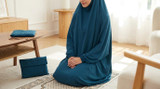
Length comes next. A prayer dress should reach the floor when you stand and still cover your ankles when you sit back. If you’re stepping on the hem walking to the mat, it’s too long. If you see skin when you rise, it’s too short. There isn’t much middle ground, which is why measurements matter more than size labels.
Then sleeves and neckline. Sleeves should reach the wrist and stay there, which is why so many good prayer dresses use elastic or snug cuffs. The neckline needs to sit high enough that nothing opens when you fold forward. Test it. Properly, with your forehead on the floor.
The Fit Test: Stand, Bow, Sit, Repeat
Before you wear a new prayer dress anywhere that matters, pray one full rakah in it at home. Bedroom floor, no audience. You’ll learn more in ninety seconds than any product photo can tell you.
Watch what happens at ruku: do the sleeves hold? At sujood: does the scarf stay put, or does it swing forward over your face? At tashahhud: does the fabric bunch under your knees or pull across your thighs? Can you breathe comfortably, and can you turn your head to make the tasleem without the neckline fighting you?
Fit in prayer clothing means room, not tent. You want enough ease that nothing clings when you’re seated, but not so much fabric that you’re gathering it up every time you stand. Many prayer dresses are cut one-size, which works well for most women and less well if you’re very tall or very petite, so check the length measurements before ordering rather than after.
Fabric matters here too, and I’d say it matters more than people admit. Breathable cotton or a soft jersey-type material is kinder in summer and doesn’t cling the way slick synthetics do. A dress that makes you sweat or crackle with static will pull your attention away from the prayer. And attention is the whole point.
The Scarf Question (and the Chiffon Hijab Nobody Mentions)
Plenty of prayer dresses come with the scarf attached, which is wonderful until you realize you want to wear your own. Plenty of other women don’t want a hood at all. Some days a stitched-on scarf is exactly right. Other days you want something lighter that you can wrap how you like.
Most people’s solution is whatever hijab was nearest, usually a printed one that’s slightly too short, or a jersey one that’s too warm for August. It works. It’s also forgettable, and it tends to slip right when you need it to stay.
The Women’s Georgette-Chiffon Hijab is a plain chiffon scarf in the Dubai style, and it solves the opposite problem: it’s light, it drapes easily over the chest, and it doesn’t feel like wearing a blanket. Chiffon moves when you move, which is lovely and also the catch. It wants an underscarf to grip. Pair it with a cotton underpiece, pin once, and you’re done. The Hijabs & Scarves section carries those underpieces too, so the whole setup can live in one order.
I keep a spare like this folded in my bag. Not because I plan to need it. Because the one day you forget your scarf is always the day you’re at someone’s house at Maghrib.
One-Piece, Two-Piece, or Just a Good Abaya?
A one-piece prayer dress with an attached scarf is the fastest option. You pull it over your head or zip it up and you’re ready in the time it takes to make wudu. It’s also easiest to travel with.
A two-piece set, a top and a skirt, gives you more flexibility on fit and makes laundry simpler, since you can wash the pieces separately. It takes a few more seconds to put on. If your body doesn’t fit one-size cuts neatly, this is usually the more forgiving route.
And then there’s the third path: skip the dedicated garment and own one loose, full-length abaya that does double duty. If that’s you, the Kaftan Abaya for Women in black is cut as everyday modest wear, with the listing mentioning mosque visits and family gatherings among its uses. Run it through the opacity and sleeve tests above before you commit it to prayer duty. A broader look at the Dresses category is also worth ten minutes if you’re not sure which silhouette suits you.
Easy Storage: Where a Prayer Dress Lives Between Prayers
Here is the part nobody plans for. The prayer dress that’s perfect in the shop ends up crushed at the bottom of a closet, or balled into a gym bag, or separated from its scarf. By the time you need it, it’s wrinkled and you’re irritated.
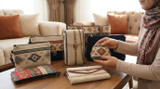
The fix is boring and works every time: give it one fixed home. A drawer, a hook by the door, a small pouch that fits in your bag. Fold it the moment you take it off, scarf tucked inside, and it comes out ready. My grandmother’s version was a flour-sack pouch. Mine is a zip bag that used to hold a pair of socks.
Keep it beside your prayer mat so the two are always together. A thick mat folded on top of a folded dress, in the corner of the room where prayer happens, becomes a kind of cue. You see them, you stop scrolling. A small tasbih tucked into the pouch makes it a complete travel set, and the handmade prayer beads collection has plenty that sit nicely in a hand.
For the office or the car, a second dress in its own pouch is worth the small expense. Choose a fabric that doesn’t need ironing. A prayer dress that requires ironing before every use is a prayer dress that stays in the drawer.
Who Are You Buying For?
A new Muslim. She doesn’t need ornate. She needs simple, forgiving, and easy to put on without a tutorial. A one-piece with a soft, opaque fabric removes one more thing to figure out.
Your mother or mother-in-law. Comfort and length come before style. She’s prayed in the same kind of cotton for thirty years, so match what she knows and upgrade the quality.
A teenager or college student. She’ll pray in a dorm, a library corner, a car. Go compact and easy to fold, in a color that isn’t going to show every mark.
Someone heading to Umrah or Hajj. Light fabric, strong coverage, a pouch. Maybe two, because laundry is complicated on the road.
A bride, a host, a friend. If you’re not sure what size or style, the Islamic Gifts collection lets you pair a smaller item with a dress, like a scarf or a tasbih, so the gift lands even if the fit is a guess.
Yourself. Honestly, this is the easiest category. Buy the dress you keep meaning to buy.
A Few Questions People Actually Ask
What should a prayer dress cover?
Everything except the face and hands, according to most scholars. Some schools treat the feet differently, so ask your imam if you’re unsure. Test the dress in ruku and sujood, not just standing.
Can I pray in a regular abaya?
Yes, if it’s opaque, loose, and stays in place in every position. Check the sleeves and hem during sujood. If you’re constantly adjusting, it’s not working for prayer.
One-piece or two-piece?
One-piece is faster and travels better. Two-piece fits more body types and is easier to wash. Pick based on how you actually pray, at home, at work, or on the road.
How do I stop it wrinkling?
Fold it into a pouch right after wearing, scarf inside. Choose a crease-resistant fabric and wash on gentle. If it needs ironing every time, you won’t wear it.
How long should it be?
Floor-length standing, with your ankles still covered when you sit back. Check the listed length against your height instead of trusting a size label.
Where to Get One
Ordering modest wear online usually means guessing at fabric and watching a tracking number crawl across an ocean. Madinah Mart is US-based and ships across the US and Puerto Rico, and the selection is curated around Islamic tradition rather than being a general marketplace with an “Islamic” filter thrown on top. Start with the Prayer Clothes collection or see what other women are choosing in Best Sellers.
After my grandmother passed, my mother opened that bottom drawer. The dress was folded inside the flour-sack pouch, scarf tucked in, the safety pin still at the corner. I still don’t know whether she pinned it for travel or out of plain habit. My mother wears it on Fridays now.
That’s all a prayer dress has to do. Be folded, and be there, and fit well enough that you forget about it by the first takbir.
May your salah be unhurried, and may getting dressed for it take about ten seconds.
Browse the full Madinah Mart collection when you’re ready.