Morning Worship Routine for Busy Muslim Professionals: Keeping Fajr Sacred Before the Calendar Takes Over
My father prayed in the kitchen. Not because we didn't have a prayer corner upstairs, but because the kitchen light was the only one he'd turn on before Fajr, and something about not waking the rest of the house felt like part of the worship itself. I remember the sound more than anything — his tasbih clicking low and steady while the coffee maker groaned behind him, like two different kinds of counting happening at once.
He was an accountant. Tie already half-knotted, laptop bag by the door, first meeting usually booked before nine. Somewhere between the sajdah and the second cup of coffee, the whole day was already pulling at him. I never once heard him complain about it, but I noticed — even as a kid — that his morning had exactly one quiet stretch, and it ended the second he picked up his keys.
That's the actual difficulty nobody names directly: it's not that busy Muslim professionals don't want a morning worship routine. It's that the job doesn't wait for you to finish it.
Here's how to build one that survives contact with a real calendar.
Why the Muslim Morning Gets Squeezed First
Worship asks for stillness. A career, especially the kind with Slack notifications and 8 a.m. standups, asks for speed. When those two things share the same thirty minutes, speed usually wins — not because anyone chooses it on purpose, but because the phone alarm is louder than the intention was.
Most working Muslims don't lose Fajr. They lose the space around it. The dhikr that used to happen slowly turns into dhikr that happens nowhere, because the fifteen minutes it needed got absorbed into checking email "just for a second." The five minutes of Qur'an before work becomes a five-minute scroll through the news instead, and by the time anyone notices, the habit is gone — not abandoned, just crowded out.
This isn't really about willpower. It's about whether the morning has the right tools sitting in the right place, so worship doesn't have to compete with logistics every single day.
An Adhan Clock That Actually Wakes You for Fajr — Not Just a Loud Noise
Most people wake up to a phone alarm that means nothing. It's the same tone that goes off for meeting reminders and grocery-pickup notifications, so the brain learns to dismiss it half-asleep, roll over, and lose the ten minutes that mattered most. Fajr needs a different kind of wake-up — one the body actually recognizes as sacred before it recognizes it as an alarm.
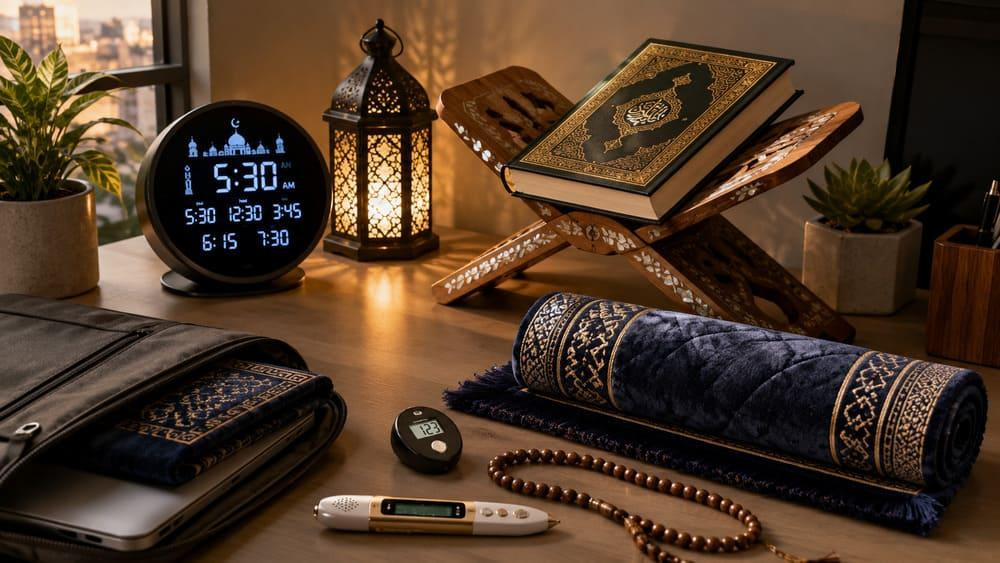
An Adhan Digital Prayer Clock solves that by waking you with the actual call to prayer, set automatically to your city's real Fajr time rather than a fixed hour you picked once and forgot to adjust. You hear the adhan, not a chime. That distinction does more for a morning routine than most people expect — the sound itself reorients you before your feet even hit the floor.
A Prayer Rug That Fits in a Desk Drawer
The office prayer problem is rarely about permission. It's about logistics — there's a supply closet or an empty conference room, but nothing to actually kneel on, and praying directly on office carpet feels wrong in a way that's hard to explain to a coworker. So Dhuhr gets pushed to the drive home, and Asr gets prayed in five minutes flat, standing in a parking garage.
A Travel Size Prayer Rug folds down small enough to live in a laptop bag without anyone noticing it's there. Thin, soft, easy to shake out and fold back up in under a minute. It removes the one excuse — "I have nowhere clean to pray" — that quietly costs more missed prayers than any meeting ever has.
A Tasbih Counter That Survives a Commute
Dhikr on the train or in traffic sounds simple until you actually try it. You lose count around forty, your hand is on the wheel or gripping a subway pole, and eventually you just stop bothering because keeping track feels like more effort than the remembrance itself.
A Digital Tasbih Counter removes the counting problem entirely. One thumb, one button, a five-digit screen that holds the number so your mind doesn't have to. Small enough for a coat pocket, a car cupholder, or a desk drawer next to the stapler. It sounds like a minor tool. It isn't — it's the difference between dhikr that gets abandoned at thirty and dhikr that actually reaches a hundred.
A Few Ayat Before You Walk Out the Door
Most working Muslims genuinely want a small portion of Qur'an before the day starts. What usually stops them isn't the desire — it's the mushaf itself, heavy and easy to lose your place in when you've got four minutes before you need to leave.
A Digital Quran Read Pen with Tajweed turns that four minutes into something usable. Touch it to the page and it recites the verse aloud with proper tajweed, in a voice that isn't yours but corrects yours anyway, just by hearing it repeated. It travels well — a nightstand tool on weekdays, a desk tool on the days you're working from home.
Giving the Mus-haf an Actual Home
Here's the quiet failure point in a lot of busy households: the Qur'an ends up in a drawer, or stacked under other books, because there was never a dedicated spot for it to rest. And a book that lives in a drawer doesn't get opened nearly as often as one that's sitting open, visible, waiting.
A Quran Holder/Stand Beech Wood Inlaid Mother of Pearl gives it that place. The pearl inlay catches light in a way a plain stand doesn't — geometric, understated, the kind of object you glance at while pouring coffee and remember what you meant to do before the day ran off with you. It folds flat, so it isn't a commitment if your space is small. It's just always there, open, waiting to be picked back up.
Who This Routine Actually Serves
Not every busy schedule needs the same version of this.
The early commuter. Fajr is non-negotiable but tight — out the door within the hour. The adhan clock and the travel prayer rug matter most here, since the whole routine has to move fast without falling apart.
The remote or hybrid worker. More flexibility, but also more distraction, since the desk is right there and email doesn't wait. The Qur'an stand earns its place on the actual desk, not tucked away — visibility is the whole strategy.
The shift worker. Fajr shifts with the season and the schedule, which makes consistency the real challenge rather than time itself. The tasbih counter travels well across whatever hours the week throws at you.
Anyone building the habit fresh. New to a structured prayer life, or trying to rebuild one that slipped during a busy season at work. Start with one tool, not five. The rug alone, used consistently, does more than a full setup used once.
A Few Questions People Actually Ask
How do I pray Fajr without waking the whole house? Keep the light low and the space small — a corner, a kitchen, anywhere that doesn't require flipping on the main lights. A travel-size rug helps here too, since it's quiet to set up and doesn't require rearranging furniture.
Can dhikr actually survive a commute? Yes, but only with something that removes the counting burden. A digital counter does that in one motion, which is usually the difference between dhikr that lasts and dhikr that quietly stops.
Is it wrong to pray fast before work? No. A shorter prayer prayed with presence outweighs a longer one rushed through half-asleep. The goal on a work morning is attentiveness, not length.
What if there's no private space at the office? Most workplaces have somewhere — a supply closet, an empty room, a corner of a stairwell. A compact rug makes almost any five feet of clean floor usable.
How long should this actually take? Fajr itself takes minutes. The dhikr and a few ayat of Qur'an can happen in the same fifteen. The routine isn't meant to add time to your morning — it's meant to protect the time that was already yours.
Where to Find These
Ordering Islamic essentials used to mean waiting on something shipped from overseas, watching a tracking number sit still for a week. Madinah Mart is US-based and ships across the United States and Puerto Rico, and the catalog is curated specifically around Islamic daily life rather than being a general marketplace with a few Islamic items tucked in. You can browse the full best sellers or see everything in all products.
Back to the Kitchen Light
My father still prays in the kitchen, even now that we're all grown and the house is quiet enough that nobody would wake up either way. Old habit, I think, more than necessity. Last year I noticed the tasbih in his hand wasn't the one I remembered — smaller, wooden, worn smooth in a way that only happens from years of the same thumb moving across the same beads. I asked him about it once. He said he didn't remember buying a new one. He thinks my mother replaced it when the old string finally gave out, and he just kept counting like nothing had changed.
That's the thing about a morning routine that actually holds. It isn't dramatic. Nobody notices the exact moment it becomes permanent. It just keeps happening, quietly, under whatever the day turns into.
Browse the full collection at Madinah Mart.