
7 Mistakes That Shorten the Life of Your Hijab
My nani owned one white cotton scarf for what felt like her whole life. I was about eight, sitting on the edge of the bathtub, watching her rinse it in the sink with a bar of soap that smelled sharp and clean. Steam on the mirror. The scarf going soft and heavy in her hands.
I asked why she didn’t just throw it in the machine with everything else. She laughed. Not at me, exactly. More like I’d asked why she didn’t leave her good dishes in the rain.
I thought about that sink for years without knowing why. Then I started buying hijabs of my own, and started watching them die. Faded at the edges. Stretched at the neck. A snag in the exact spot where the pin always went. Most of those scarves didn’t wear out. They were worn down, by us, through small habits nobody ever flagged.
Here are the ones that shorten the life of your hijab, and what to do instead.
Why Hijabs Die Younger Than They Should
A hijab is the hardest-working piece of fabric you own. It’s on your head before sunrise, it goes through salah, school runs, the commute, the heat of a kitchen on a Friday, and somebody’s perfume at the end of the day. Then it goes in the laundry basket, usually knotted around three other things.
Nobody gives it the care a wool sweater gets. And yet it touches skin, hair, oil, sweat and sunlight every single day. Of course it wears out.
The good news is that almost none of the damage is dramatic. It’s small, repeated stuff. Which means it’s fixable without changing your life.
1. Washing It Hot With Everything Else
The default laundry day: hijab goes in with jeans, a hoodie with a zipper, maybe a towel. Hot cycle, fast spin.
Zippers and hooks catch fine weaves. Heat relaxes fibers and fades color. Fast spinning twists a lightweight scarf into a rope. You can see it in the result: a hijab that came out clean but somehow looks older.
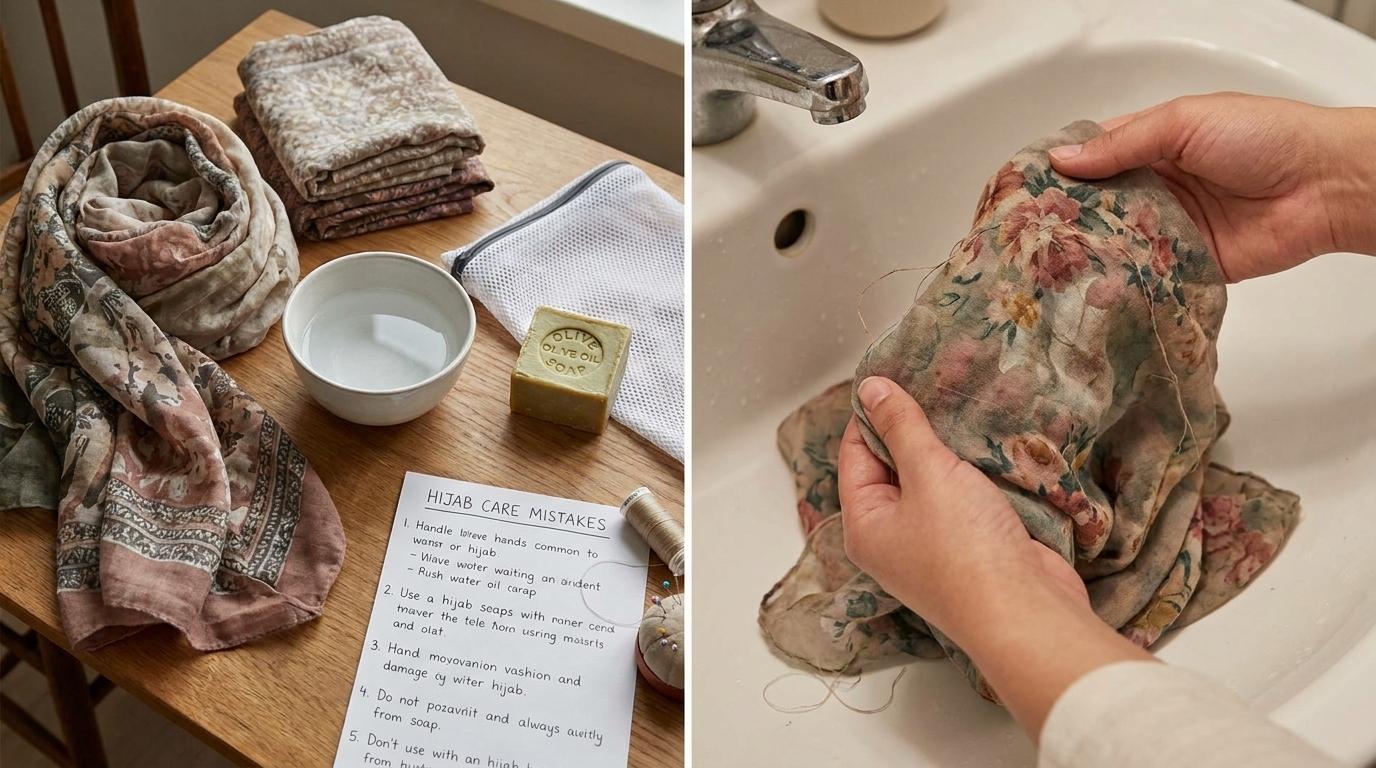
Wash it cold, on a gentle cycle, in a mesh bag if you have one. Or do what my nani did and wash it by hand. It takes two minutes, honestly, and it adds years.
If you’re starting fresh, a cotton-viscose scarf like the Crinkle Lightweight Cotton Hijab Scarf is a forgiving place to begin. It’s a 65% viscose, 35% cotton blend, roughly 180cm by 90cm, with a permanent crinkle texture that hides the small creases laundry leaves behind. That’s the kind of fabric that doesn’t punish you for being busy.
2. Wringing It Out Like a Dishcloth
You’ve rinsed it. It’s dripping. Your hands do the obvious thing and twist.
Don’t. Wet fibers are weaker than dry ones, and twisting stretches them past where they spring back. It’s how scarves end up with that limp, uneven hang that no amount of styling fixes.
Press the water out instead. Lay the hijab flat on a clean towel, roll it up, and squeeze gently. Done. It’s a little more effort than wringing, but your scarf comes out the same shape it went in.
3. Drying It in the Sun or the Dryer
Both are heat. Both are tempting.
A hot dryer shrinks and roughens delicate fabrics, and it’s especially unkind to stretchy ones. Direct sun on the balcony rail is gentler, but it fades dark colors faster than you’d expect. Black turns slightly gray. Deep navy loses its depth.
Dry flat or hung in the shade, away from a heater. If you wear jersey, flat is better, because hanging a wet stretchy scarf by one edge lets gravity pull it out of shape.
That’s where a Fashion Scarf Premium Jersey Hijab earns its place in a rotation. It’s made from a modal rayon blend and feels soft and breathable, which is exactly why it deserves the flat-dry treatment. Soft fabrics reward patience.
4. Ironing at the Wrong Temperature
This one catches people who are careful about everything else.
Chiffon and polyester voile can scorch or go shiny under a hot iron. You often won’t notice until the mark is already there, a faint glossy patch near the edge. And on a crinkle scarf, ironing it flat undoes the entire point of the fabric.
Check the fabric first. Use low heat for delicate weaves, put a thin cotton cloth between the iron and the scarf, and skip ironing altogether for anything designed to be wrinkle-forgiving.
If ironing every morning feels like a chore you resent, you may simply be wearing the wrong fabric for your life. A Soft Stretch Scarf/Hijab Voile is built with a little flexibility so it wraps easily and holds in place, which means less fussing and less need to press it flat in the first place.
5. Pinning Through the Same Spot, Every Single Day
Pins are useful. Pins are also tiny needles you push through your fabric daily.
Do it in the same place, in a fine fabric, for months, and you get a pulled thread. Then a hole. Chiffon shows this first, though jersey isn’t immune.
Rotate where you pin. Use smooth pins with no burrs. And honestly, consider a fabric that grips on its own, because the best pin is the one you don’t need. The crinkle scarf above is described as non-slip for exactly that reason.
For days that call for something lighter and dressier, the Chiffon Hijab, Rectangle drapes beautifully. It’s lightweight and breathable. It’s also the scarf that asks the most gentleness from your pins, so pick that spot carefully.
6. Putting It Away Damp, Balled Up, or Crushed Under Other Things
The scarf that’s almost dry gets folded into the drawer. A week later it smells faintly stale, even though it looks fine.
Damp storage invites mildew and odor. A tight ball makes creases that become permanent in some fabrics. A heavy pile on top of it flattens the texture.
Make sure it’s completely dry before it goes away. Fold stretchy ones, hang lightweight ones from a soft hanger if you have the space, and don’t cram them into a bag. If you like a drawer that smells good, a small scented sachet near the scarves is gentler than spraying anything on them.
7. Wearing the Same Scarf Every Day Until It Gives Up
Everyone has a favorite. It goes with everything, it sits right, it takes no thought. So it goes on every single day, and it gets washed every other day, and eventually it wears out all at once.
Fabric needs rest. A small rotation of three or four scarves means each one gets worn less and washed less. That alone can double how long they last.
A Nitara Floral Printed Cotton Scarf is a nice second voice in a rotation. It’s printed Indian cotton, available in four prints, and it breathes well in warmer weather. Having a few different textures to reach for means no single scarf takes the whole beating.
Who’s Wearing What? A Quick Guide
Different lives are hard on hijabs in different ways.
The everyday commuter wants low-maintenance. Crinkle is the move: it forgives rushed mornings and skips the iron.
The working-from-everywhere hijabi needs breathable and soft. Jersey or stretch voile, rotated through the week.
The one who dresses up for events should keep a chiffon for those days only, and treat it gently. Don’t wear it to the gym. Don’t pin it hard.
The new hijabi benefits from starting with two or three affordable scarves rather than one expensive one. You’ll learn what suits your day before you invest more.
The gift-giver can’t go wrong with a cotton print in a color the person already wears. It’s a practical gift that doesn’t feel generic.
A Few Questions People Actually Ask
How often should I wash my hijab?
After every one or two wears, depending on weather and how much you sweat. Scarves touch skin, oil and hair products, so waiting longer lets buildup set into the fibers.
Can I put my hijab in the washing machine?
Yes, on a cold, gentle cycle, ideally in a mesh bag and away from zippers or hooks. Hand washing is gentler if you have a few minutes.
Why does my hijab get rough or pilly?
Usually friction and heat. Hot washes, the dryer, and rubbing against bags or seat belts wear the surface down. Cooler washing and air drying slow it a lot.
How do I stop pins from damaging my hijab?
Rotate where you pin, use smooth ones, and choose a non-slip fabric when you can. Fewer pins means fewer holes.
How many hijabs should I own?
Enough to rotate, so three or four is a sensible start. No single scarf should be worn daily without a break.
Where to Buy
If you’ve ever ordered modest wear from overseas and refreshed a tracking page for three weeks, you know the feeling. Madinah Mart is US-based and ships across the US and Puerto Rico. The selection is built around Islamic tradition rather than being a general marketplace with a filter added on. Start with the Best Sellers or browse the full Hijabs & Scarves collection.
Back to the Sink
My nani’s white scarf is in my drawer now. It has a small darned patch near one corner, a few careful stitches in thread that doesn’t quite match. I don’t know if she did it herself or if one of my aunts fixed it for her one year. Nobody remembers.
It’s softer than anything I’ve bought. Thinner, too, in a way that looks fragile and isn’t. It has been washed in a sink with a bar of soap more times than I could count, pressed in a towel, laid flat to dry.
That’s really the whole lesson. A hijab doesn’t last because it’s expensive. It lasts because someone treated it as though it mattered.
May what you wear to salah last you years, and may it carry a little barakah along with it.
Browse the full collection at Madinah Mart.