
Kids' Islamic Bedroom Decoration Ideas: Making a Room That Actually Feels Like Home
My nephew Yusuf moved into his "big boy room" the summer he turned four. My sister spent a weekend painting the walls a soft grey-blue, and by Sunday night the crib was gone and there was a real bed against the wall, low enough for him to climb into on his own. He stood in the doorway for a second before he walked in. Then he asked where his stars were.
She hadn't thought about that. Neither had I. We'd talked about the bed, the paint, the little shelf for his books — the practical stuff. Nobody had thought about what actually makes a room feel like his, the way it did before, when the crib had a mobile with tiny felt moons hanging over it. A room can be perfectly decorated and still feel like a hotel if nothing in it belongs to the kid who has to fall asleep there.
That's the real difficulty with a Muslim kid's bedroom. It's not finding wall art. It's building a room where the deen isn't a poster you bought once and forgot about, but something woven into the ordinary furniture of a child's day — what they see when the light's still on, what they touch before they fall asleep, what's sitting on the shelf when they wake up scared at 2 a.m.
Here's what actually works, room by room, corner by corner.
Why a Kids' Room Is Harder to Get Right Than It Looks
Adults decorate for themselves. A framed Ayat al-Kursi in the hallway, a nice sajadah folded in the corner of the bedroom — that's for a grown person who already understands why it's there. A child doesn't come with that context built in. You're not just decorating a room. You're quietly building the first version of what "home" means to someone who's going to carry that association for the rest of their life.
Get it wrong and the room just has stuff in it — an Arabic poster next to a dinosaur lamp, competing for attention, neither one really landing. Get it right and a five-year-old points at the wall above their bed and tells a guest what it says, without anybody asking them to.
1. Start With What They'll Actually Look At — the Wall Above the Bed
Most kids' rooms have one wall that gets looked at more than any other: the one facing the bed. It's usually the last thing a child sees before falling asleep and the first thing after waking up. In a lot of homes, that space gets filled with whatever was easiest — a movie poster, a blank stretch of paint, nothing at all.
The Elegant Handmade Carpet-Wall Hanging Ayat al Kursi works there in a way a printed canvas doesn't. It's Egyptian-made, embroidered rather than printed, so there's actual texture to it — something a kid notices even if they can't explain why it looks different from a poster. You're not decorating with a verse. You're putting the verse somewhere it gets read, quietly, every single night, whether or not anyone's testing them on it.
2. Let Bedtime Do Some of the Teaching — a Night Light With the Quran Built In
Almost every kid goes through a phase where the dark is a problem. You can fight that with a plain nightlight from the hardware store, or you can let the fix double as something else.
The 3D Moon Quran Speaker Night Light is a crescent-shaped lamp that also plays Quran recitation — Bluetooth-connected, so you can pick the reciter, dim the glow, and let it run low in the background while a child drifts off. It's not flashy. It's a soft light shaped like the moon that happens to be reciting Ayat al-Kursi while your kid falls asleep, which is a very different thing than a nightlight shaped like a cartoon character that does nothing but glow.
If you'd rather keep it simpler, the Allah Written-Calligraphy LED Night Light is a 3D illusion lamp on a wood base — no app, no sound, just a warm daylight glow with the calligraphy lit from inside. Some kids want the recitation. Some just want the light on. Both are doing the same quiet job.
3. Give the Alphabet Somewhere to Live — a Learning Corner, Not a Flashcard Pile
Every Muslim parent I know has a stack of Arabic flashcards somewhere in a drawer, half-used, mostly forgotten. Flashcards get put away. A puzzle board on a shelf gets picked up.
The Arabic Alphabet Wooden Educational Toy is a colorful wooden board where each letter piece comes with an illustration — an animal, a fruit, something the letter sound is tied to. Sturdy, smooth edges, made for small hands to actually manage on their own. For a slightly more hands-on version, the Furqaan Puzzles Madinah set is a 3D wooden Arabic puzzle board built specifically for preschool-age learning, and the Magnetic Arabic Board turns the whole thing into a low-pressure spelling game with twenty-eight magnetic letters a kid can move around a wall or easel without anyone standing over them correcting mistakes.
None of these look like schoolwork. That's the point. A child who's building words with a magnetic letter because it's fun isn't thinking about the fact that they're learning Qaida. They're just playing.
4. Make Salah Something They Can Touch, Not Just Watch
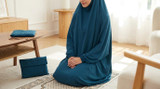
Most Muslim households have a prayer rug somewhere a child has watched a parent use — usually from a distance, usually told to be quiet during it. Prayer, from a kid's perspective, is often something that happens to other people in the room.
The Interactive Coloring Prayer Rug changes that math. It's a washable, non-slip mat printed with seven black-and-white designs a child colors in themselves using the twelve included markers, and once it's colored, it dries and becomes a real, usable sajadah — one they made. It's not a toy that resembles a prayer rug. It's a prayer rug a child had a hand in creating, which means the first time they kneel on it, they're kneeling on something they own in a way that has nothing to do with who bought it for them.
5. Let the Room Grow Up a Little — an Adhan Clock for the Older Kid
Somewhere around seven or eight, a child's room starts needing less decoration and more structure. This is usually when parents start trying to teach the five daily prayers as something with actual timing attached, not just something that happens when a parent says so.
The Digital Adhan Automatic Alarm Wall-Clock calls the full azan for all five prayers, displays the time and date on a full screen readable in the dark, and can be set to a soft beep instead of the full call if a household prefers that. Mount it on the wall of an older kid's room and prayer stops being an abstract instruction and becomes something the room itself keeps track of.
6. Not Everything Has to Be a Lesson — a Soft Companion for the Youngest Ones
Not every corner of the room needs to be doing something educational. Little kids still need something soft to hold onto, and there's no reason that has to compete with the rest of the room's theme.
The Plush Toy Lamb Stuffed Animal is a knitted, eco-friendly cotton lamb — soft, simple, and for a lot of Muslim families, quietly tied to Eid al-Adha conversations that come up naturally as kids get old enough to ask questions about Qurbani. It doesn't need to be explained. It just needs to be there, on the bed, for the nights nothing else in the room is what a four-year-old actually wants.
Which Room Are You Actually Decorating?
Not every kid's room needs the same things, and trying to fit all of it into one room usually means none of it gets used.
The toddler's room. Keep it simple and soft. The night light, the plush lamb, maybe the wall hanging above the crib rail where it's visible but out of reach. Nothing that requires attention span yet — just presence.
The early learner's room, roughly four to seven. This is where the puzzle boards and the coloring prayer rug earn their place. The child is starting to ask "why," starting to want to do things themselves rather than watch them happen. Give them things their hands can be part of.
The older kid's room, eight and up. Less toy, more structure. The adhan clock belongs here. So does a proper wall hanging that isn't going to feel babyish in two years — Ayat al-Kursi doesn't age out the way a cartoon poster does.
A Few Questions People Actually Ask
Is it okay to have a night light that plays Quran recitation all night? Most families run it at low volume for the first stretch of sleep rather than all night, since a child's sleep is lighter earlier on. Many of the Bluetooth models let you set a sleep timer for exactly this reason.
What age can a kid actually use the Arabic puzzle boards? The wooden alphabet boards are generally built for ages three and up, since the pieces have easy-grip knobs made for smaller hands. Younger toddlers will mostly chew on them, which is fine — that's still how a lot of early learning starts.
Does the coloring prayer rug wash out after use? It's designed to be re-colored — kids draw on it, let it dry, and can redo the designs later, so it holds up to repeat use rather than being a one-time craft project.
My kid's room is small. Where do I even start? Start with the wall above the bed and the night light. Those two do the most work in the least space, and everything else can be added later as the room, and the kid, grows.
Where to Actually Buy This Stuff
Ordering Islamic decor used to mean either a long wait on something shipped overseas or settling for a general marketplace's idea of what "Islamic" means, tucked between unrelated categories. Madinah Mart is US-based, ships across the US and Puerto Rico, and the selection is actually curated around Islamic tradition rather than a general store with an Islamic filter thrown over it. You can browse the full Islamic Gifts collection or start with the Best Sellers if you'd rather see what other families are already choosing.
Back to the Room With No Stars
I asked my sister about it a few weeks later. Yusuf's room has the moon lamp now, on the little shelf near his bed, and she said the first night it was there, he asked her to leave it on low and play "the reciting one" — his words, not the actual name of anything. He fell asleep before the second surah ended.
She didn't plan that. She just needed something to fix the dark, and it happened to also be doing something else the whole time. That's usually how the good version of this works. You're not building a themed room. You're just making sure that when a kid looks around at 2 a.m., something in there is quietly, steadily on their side.
Browse the full collection at Madinah Mart.