How to Style a Kaftan for Casual and Special Occasions
My mother kept one kaftan in a garment bag at the very back of her closet, separate from everything else she owned. Not folded in a drawer like her house clothes. Hung up, zipped in, like it needed protecting. I was maybe ten the first time I asked why, and she said something I didn't understand until years later — that a kaftan isn't really one piece of clothing. It's however many pieces of clothing you decide to make it.
That answer used to annoy me. Now I think she was right, and I think most women don't actually believe her yet.
Because here's the real problem. Kaftans get filed into one of two boxes and left there. Either they're "the loungewear thing" — soft, shapeless, fine for the house and nowhere else — or they're "the wedding thing," pulled out once a year, heavily embroidered, put back the second Eid ends. Almost nobody treats the kaftan as what it actually is: one of the few garments flexible enough to go from a Tuesday errand run to a formal gathering, with the right choices around it.
So here's how you actually do that.
Why the Kaftan Gets Misunderstood
Part of it is fabric confusion. A heavy, richly embroidered kaftan and a light, breathable one are functionally different garments that happen to share a silhouette, and people shop for one when they need the other. The rest of it is styling — nobody's ever really been shown how to dress a kaftan down for daily life or up for an occasion that matters, so it sits in one lane by default.
The fix isn't complicated. It comes down to reading the fabric, choosing the right accessories, and understanding that a kaftan you'd wear to drop the kids off is not the same kaftan you'd wear to a wedding — even if, technically, they're both kaftans.
For the Days You Just Need to Leave the House
Most women own at least one kaftan that's too nice for the couch and not nice enough for anything else. It sits there, unworn, because nobody's told them it can do casual duty too — flats, a light scarf, done in under five minutes.
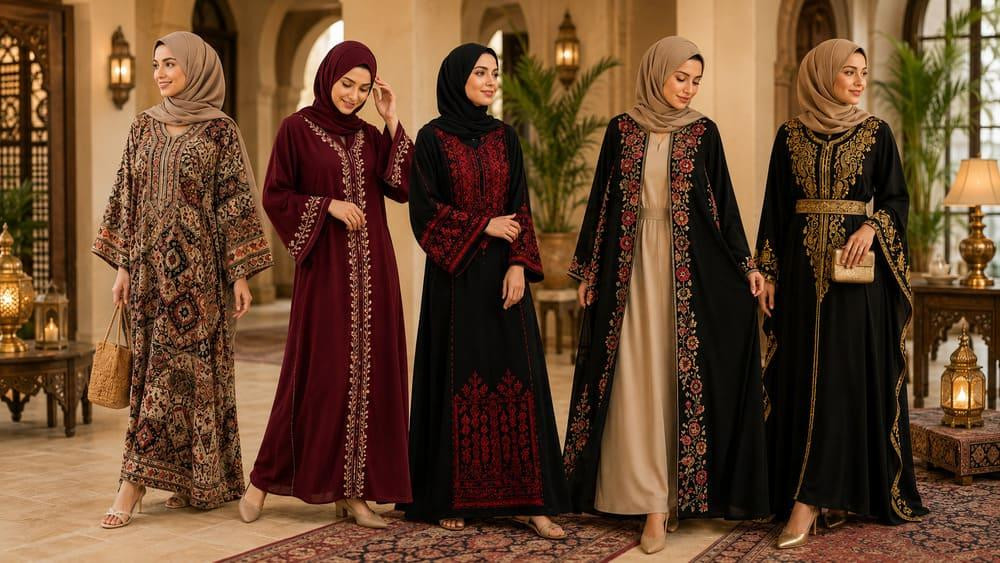
A soft, breathable fabric is what makes that possible. The One-Size Abaya Kaftan for Effortless Elegance & Comfort is cut loose enough to move in — grocery run, school pickup, a coffee with a friend — and the ethnic print does the work a plain black abaya can't; you don't need jewelry, you don't need a statement bag, you just need shoes you can walk in. Pair it with simple flats and a cotton hijab in a solid color and you're finished getting dressed before your coffee's cold.
The Everyday Kaftan Worth Keeping in Rotation
There's a version of "casual" that still wants a little polish — not loungewear, but not trying too hard either. That's a harder gap to fill than people expect, because most casual pieces read as sloppy the second you add real light.
The Maroon Abaya with Beige Embroidery sits right in that gap. The fabric is light enough for long hours — worth mentioning if you're wearing it through a full day of errands, prayer, and everything in between — and the beige embroidery gives it just enough structure that you can walk into a casual family lunch without changing first. Roll the sleeves slightly if the cut allows it, add a simple pendant, and it reads finished without reading formal.
When Tradition Does the Talking
Some kaftans carry embroidery that's already doing all the visual work, and the instinct to add more — more jewelry, more pattern, more color — actually works against the piece instead of for it.
The Palestinian-Inspired Kaftan Dress is a good example. The embroidery references a classic thobe, so the dress is already telling a story before you've added anything. Let it. Keep the hijab plain, skip the layered necklaces, and let the flowy cut and the pattern be the whole outfit. This is a kaftan that moves between casual and formal depending only on what shoes you put under it — sandals for a family visit, heeled slides for something more dressed up.
For the Occasions That Actually Call for Gold
Then there's the kaftan you reach for when the occasion has weight to it. Eid, a wedding, a night where the room itself is dressed up and you need to match it.
The One-Size Kaftan Abaya in Black and Gold is built for exactly that register. The gold detailing across the front and sleeves already reads as "special occasion," so the rest of the styling should stay restrained — gold or brass jewelry to echo the embroidery rather than compete with it, heels if you're standing for photos, and a hijab that picks up either the black or the gold rather than introducing a third color. This is the kaftan that does the least work when you're the one under-dressed, over-committed, and short on time before you walk out the door.
Layer It — Don't Just Wear It
This is the move most people skip entirely, and it's the one that changes a kaftan from "a dress" into "an outfit." An open kaftan, worn over something simple underneath, functions almost like a coat — and it's the fastest way to take a plain look and make it feel intentional.
The Vibrant Embroidered Open Abaya works this way. Sheer, open at the front, heavily embroidered around the neck and chest — worn closed, it's a full kaftan. Worn open over a plain underdress or a simple abaya, it becomes a layering piece, the kind you'd throw on top of an otherwise ordinary outfit to make an entrance without changing your entire wardrobe. This is the trick my mother's generation actually knew and mine mostly forgot: the kaftan doesn't have to be the whole outfit. Sometimes it's just the best part of it.
The Heritage Piece That Earns Its Place at the Wedding
Some kaftans are built specifically for the occasions where tradition matters as much as the fit — a wedding, an engagement, a gathering where the older women in the room will notice the embroidery before they notice anything else.
The Traditional Palestinian Thobe with Exquisite Embroidery is one of those. The waist detail shapes the silhouette without losing the modest drape, and the embroidery is dense enough that it needs almost nothing added — a plain hijab, minimal jewelry, done. This isn't a piece you style around. It's a piece you get out of the way of.
Who Are You Dressing For?
A quick note, because the same kaftan can serve different people differently depending on what the day actually calls for.
The errand-day version of you wants breathable fabric, flats, and nothing you have to think about twice — that's the effortless-elegance kaftan territory.
The family-gathering version of you wants something with a little embroidery but nothing that needs ironing three times — the maroon abaya or the Palestinian-inspired kaftan both live here.
The wedding-guest version of you wants gold, structure, and shoes with a heel — that's the black-and-gold kaftan.
The "I want to be remembered" version of you wants heritage embroidery doing the talking, minimal accessories, and a hijab that doesn't compete — that's the traditional Palestinian thobe.
Most women need at least two of these in rotation, not one kaftan trying to do all four jobs at once.
A Few Questions People Actually Ask
Can I wear a kaftan casually, or does it always look dressed up? It depends entirely on the fabric and embroidery density. A lightweight, minimally embellished kaftan styled with flats and a plain hijab reads completely casual — the heavier, gold-detailed pieces are where it shifts formal.
What shoes go with a kaftan? Flats or sandals for daytime and casual wear, heels or dressy slides for evening occasions. The kaftan's hemline and formality should guide the shoe, not the other way around.
Do I need to layer a kaftan, or can I wear it alone? Either works. A closed kaftan stands on its own as a full outfit; an open-front style is meant to be layered over a simple underdress for a more elevated look.
How do I choose a hijab to go with an embroidered kaftan? Match one color from the embroidery rather than introducing something new, or keep it plain if the embroidery is already dense. Busy patterns paired with busy embroidery tend to compete rather than complement.
Is one kaftan enough for both casual and special occasions? Not really. Fabric weight and embroidery level change what an occasion calls for, so most women end up with at least one lighter, everyday piece and one heavier, occasion-ready piece.
Ordering From Madinah Mart
Finding a kaftan that actually looks like what's pictured — instead of a thinner, stiffer version that shows up weeks later from an overseas seller — has been its own kind of frustration for a long time. Madinah Mart ships across the US and Puerto Rico, and the clothing selection is curated around modest Islamic and cultural fashion specifically, not dropped into a general marketplace with a filter slapped on top. You can browse the full dresses collection or check the best sellers if you want to see what other women are already reaching for.
Back to That Garment Bag
I still think about my mother's kaftan sometimes, zipped away like it mattered more than the rest of her closet. Years later I found out why she kept it separate — it wasn't one kaftan at all. She had it altered twice, once to loosen the sleeves for everyday wear and once to add a sash for a cousin's wedding. Same dress, different life each time she put it on.
That's really the whole point. A kaftan isn't casual or formal. It's whatever you build around it.
Browse the full collection at Madinah Mart.