Helping Children Build a Love for Salah: Small Steps That Actually Stick
My niece Aaliyah started climbing onto the corner of my sister's prayer rug when she was about three. Uninvited, barefoot, completely unaware of what she was doing. She'd copy the ruku and sit down too early for the sujood, giggling into the carpet. My sister never stopped her. She just kept praying, and Aaliyah kept climbing on.
By the time Aaliyah turned six, the climbing had stopped being cute and started being a problem. She knew the movements by then, mostly, but the wandering off mid-rakah hadn't gone anywhere. My sister would call her back three times in one salah. What used to be a toddler charming her way onto a prayer rug had become something closer to a negotiation. Nobody wants that. You want your child to love salah, not tolerate it the way she tolerates vegetables.
Here's what's actually worked in the households that get this right.
Why This Is Harder Than It Looks
Salah asks a lot of a young child. Stand still, say words in a language you don't speak yet, bow, prostrate, repeat, understand almost none of it — and do this five times a day for the rest of your life. Adults forget how strange that is from the inside. We learned the choreography so early it feels like breathing. A four-year-old is being asked to memorize a sequence with no visual cues and no obvious payoff.
Most households solve this by correcting. "Stand up straight." "Say it again." "Watch me." Correction teaches compliance. It rarely teaches love. A child who's been corrected through every salah for two years associates prayer with getting things wrong, not with anything that belongs to her. That's the actual problem — not that kids won't sit still, but that nothing about the process gives them a reason to want to.
The households where kids come to genuinely love salah tend to do one thing differently: they make the learning part visible and separate from the actual worship, so correction during real prayer becomes rare.
The Salah Mat That Teaches Instead of Just Reminding
Most kids learn salah by watching a parent and getting corrected in real time. That works eventually, but it's slow, and a lot of the instruction happens mid-prayer, which is exactly when a child shouldn't be getting talked at.
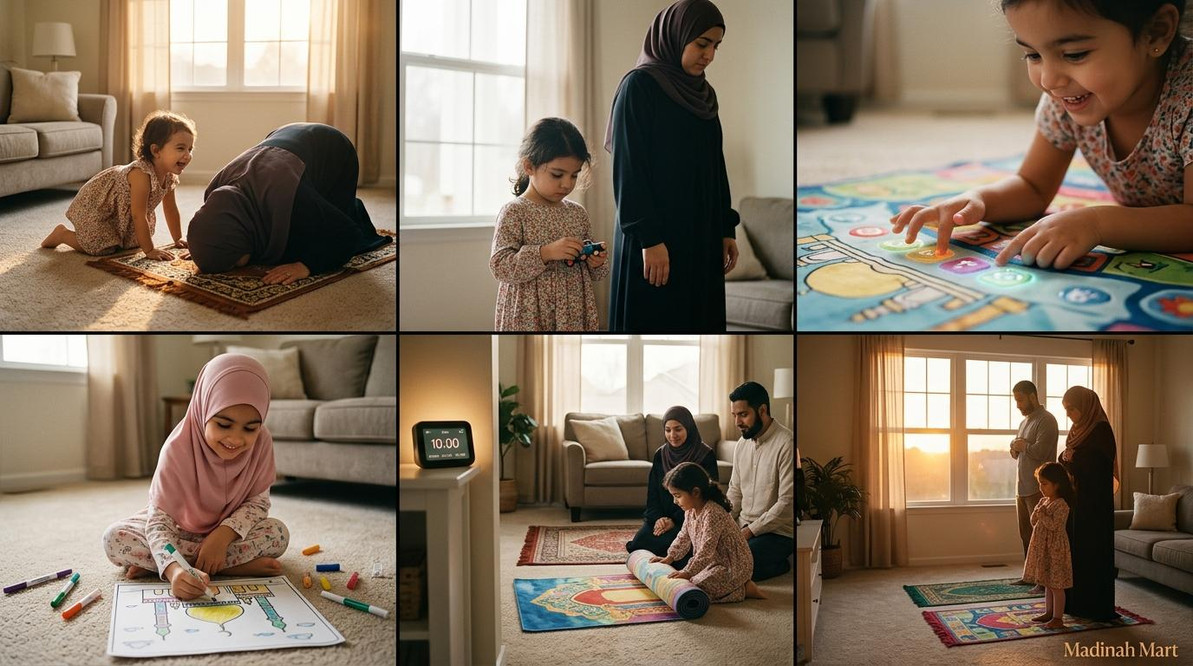
The Interactive Kids Prayer Mat solves that by moving the teaching into the mat itself. It's built for ages two to six, with 36 touch-sensitive keys placed where the hands, feet, and forehead land during salah. Step onto the mat and it responds — Qur'an recitation, du'as, spoken instructions for wudu, guidance through all five daily prayers. The speaker sits at the top of the mat now, not near the feet, so a small child doesn't end up stepping on it mid-sujood and losing the audio. It plays in ten languages, and the newest version includes a full 2-rakat salah translation, so a child isn't just repeating sounds — she's hearing what the words actually mean, in English, while she prays them in Arabic. It also comes in a blue version, if pink isn't the household's thing.
What this does, practically, is take the parent out of the correction seat. The mat corrects. The parent gets to just watch, which changes the entire emotional tone of the thing.
A Prayer Rug a Child Actually Wants to Kneel On
Before Aaliyah had her own space to pray on, she was praying on the edge of someone else's rug, half in and half out. That's common. Most families don't think to give a young child their own prayer rug until it starts feeling necessary rather than nice.
It should probably happen earlier. A child with her own rug — sized for her, patterned in a way that actually interests her — treats prayer differently than a child borrowing a corner of an adult's space. The children's prayer rug with a mosque illustration is designed specifically around this — a colorful mosque scene woven into the rug, something for a young child to actually look at and connect with rather than a plain adult mat scaled down. Ownership matters more than people give it credit for. A rug with her name attached to it, even informally, becomes hers in a way that changes how she shows up to it.
Turning Wudu and Salah Into Something They Color
At some point between the sensor mat and the real thing, there's a gap. A child who's outgrown needing audio guidance but hasn't developed the habit yet needs something in between — something that keeps salah playful without doing the praying for her.
The Interactive Coloring Prayer Rug fills that gap oddly well. It's a washable, non-slip mat with seven black-and-white designs and twelve washable markers included. A child colors the rug herself, lets it dry, and prays on something she made. It's reusable — wash it out, color it again. Perfect For Ages 2-6, technically, though plenty of eight-year-olds would still ask for one. This will sound like a low-effort suggestion for something as serious as salah. It isn't. Ownership through creation is a different kind of ownership than being handed a finished object, and kids notice the difference even if they can't say why.
The Bundle That Makes Learning Prayer a Family Habit
Books work. They just work slower, and usually alongside something more hands-on rather than instead of it.
The Little Muslims Prayer Pack Bundle brings together three pieces built for exactly this stage: an illustrated book that teaches the names of the five daily prayers through rhyme and Arabic text, a laminated card game that walks a child through wudu and the steps of salah with clear images, and a memorization book of authentic du'as and surahs with English translation. None of it is flashy. It's the kind of set that lives on a shelf near the prayer corner and gets pulled down a few times a week — before bed, on a weekend morning, whenever a child asks a question a parent doesn't quite know how to answer on the spot. The card game especially tends to get used more than expected, because it doesn't feel like homework. It feels like a game, which — obviously — is the entire point.
An Adhan Clock That Calls the Whole House to Pray
None of this matters much if the household itself doesn't have a visible rhythm around prayer times. A child who never hears the adhan called at home learns salah as something private and self-initiated, which is a harder thing to build a habit around than something communal.
The Adhan Digital Prayer Clock plays the full adhan for all five daily prayers, automatically adjusted to the local city, with both Hijri and Gregorian calendar display. It's not marketed as a kids' product, and it shouldn't be — this one is for the whole house. But that's exactly its value here. When the adhan is something a child hears out loud, called into the living room the same way it would echo through a masjid, prayer stops being one parent's private routine and becomes something the whole family visibly does together, five times a day, without anyone having to announce it.
Which Stage Is Your Child In?
Toddlers, roughly two to four — this is the imitation stage. They don't need to understand salah yet; they need to be near it. The sensor mat and the child-sized mosque rug both work here because they let a toddler participate without pressure to get it right.
Early school age, five to eight — this is where habit actually starts forming, and where the coloring rug and the prayer pack bundle earn their place. Kids at this age want ownership and a bit of narrative — a book, a game, something with characters and a story, not just repetition.
The whole household, any age — an adhan clock isn't really a kids' product or an adults' product. It's a house product. It's the thing that makes salah feel like the family's rhythm instead of one parent's private discipline that the kids are expected to eventually adopt.
A Few Questions People Actually Ask
At what age should I start teaching my child to pray? Most scholars point to around age seven for formal instruction, with encouragement (not obligation) starting well before that. Letting a toddler imitate salah near you, without correction, is doing more good than it looks like.
My child copies the movements but doesn't understand them. Is that normal? Completely. Understanding comes later than imitation, sometimes years later. The goal at a young age is comfort and familiarity, not comprehension.
How do I make Fajr easier for a child who's just starting to join in? Keep expectations small. A child joining for even one or two rakahs at Fajr, sleepily, without being pushed to do the full prayer, is still building the habit. Consistency matters more than completeness right now.
Does my child need their own prayer rug, or can they just use ours? They don't need one. But a rug that's clearly theirs tends to change how seriously a child treats the space, especially once they're old enough to notice it's "their" spot.
What if my child loses interest after a few weeks? That's not failure, it's normal. Interest in salah at a young age tends to come in waves. Keep the routine visible and low-pressure, and the interest usually comes back on its own.
Where to Actually Get This Stuff
Ordering Islamic products used to mean watching a tracking number crawl across an ocean for three weeks, hoping customs didn't hold it up before Ramadan. Madinah Mart is US-based and ships across the US and Puerto Rico, so that particular kind of waiting isn't part of the experience anymore. The selection is also curated specifically around Islamic home and family life, rather than being a general marketplace with a filter slapped on top. If you want to see what else is out there beyond what's mentioned here, the Islamic gifts collection and the best sellers page are the two places worth starting.
Back to the Rug Corner
Aaliyah is eight now. She still climbs onto a prayer rug uninvited, except it's hers, and nobody has to call her back mid-rakah anymore. My sister told me the shift happened somewhere around the time she got her own coloring rug — she colored it wrong on purpose the first time, some argument about which mosque design she wanted, and my sister let her redo the whole thing rather than correct her. I don't think my sister planned that as a lesson. She just didn't want to fight about it.
That's the thing about building a love for salah in a child. It's rarely one big intervention. It's mostly just getting out of the way at the right moments and letting ownership do the rest.
Browse the full collection at Madinah Mart.