
Simple Habits That Help You Never Miss Fajr Again
My brother used to sleep through Fajr constantly. Not occasionally — constantly. He had three alarms lined up on his phone, ten minutes apart, and somehow all three would go off, get silenced in his sleep, and he'd wake up at eight with that specific guilt on his face. My mother never said much about it. She'd just quietly ask, "Salleit el Fajr?" and he'd look at the floor.
The thing nobody tells you about missing Fajr is that it's rarely about laziness. It's about friction — the fifteen seconds between the alarm sound and the decision to actually get up, repeated every single dawn for years. Willpower runs out fast at 5 a.m. What doesn't run out is a system that removes the decision entirely.
Here's what actually changed things for him. Not motivation. Not guilt. A handful of small, physical habits that made getting up the easier option instead of the harder one.
Why Fajr Is Different From Every Other Prayer
Dhuhr, Asr, Maghrib, Isha — you're already awake for those. Your body is upright, your mind is functioning, the hardest part is just remembering. Fajr asks something else entirely. It asks you to interrupt sleep at its deepest point, when your body temperature is lowest and your motivation is essentially zero, and choose Allah over the warmest, most comfortable five more minutes you'll get all day.
The Prophet ﷺ knew this. That's why the reward attached to Fajr in congregation is so specific — a night spent in prayer, according to the hadith. Not because Fajr is more important than the other four. Because it's harder. The reward matches the difficulty.
So the goal isn't to fight your nafs into submission through sheer discipline every single morning. That's exhausting and it fails eventually, for everyone. The goal is to build a small environment around yourself where the right choice takes less effort than the wrong one.
An Alarm That Doesn't Let You Bargain
Most people miss Fajr because of the snooze button, not because of the first alarm. You hear it, your hand finds the phone in the dark, and some sleepy negotiation happens in about two seconds. "Five more minutes." Five becomes twenty. Twenty becomes Fajr time passing.
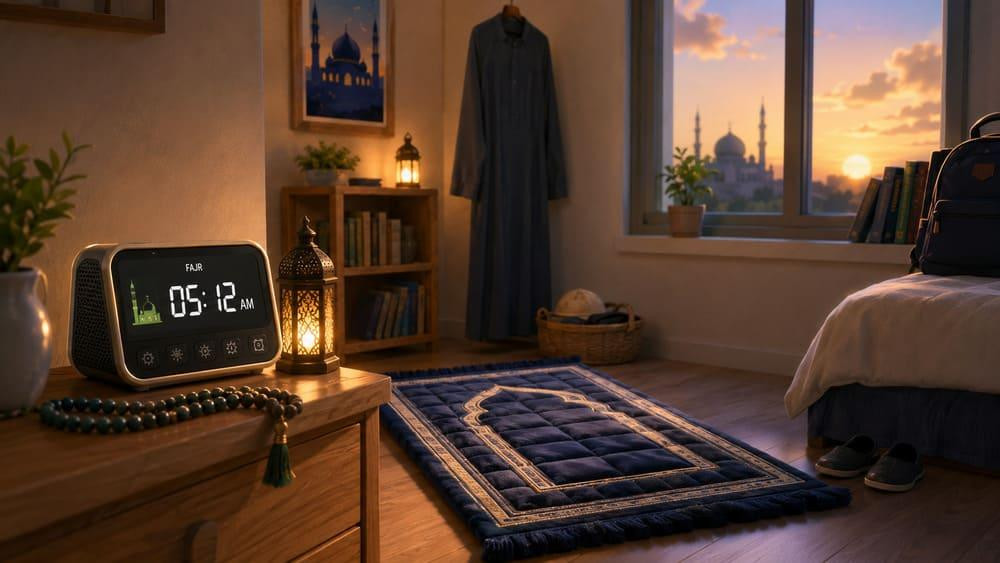
A phone alarm is easy to bargain with because it's small, it's soft, and it's right next to your hand. What actually works is putting real distance and real sound between you and the snooze decision. The Digital Adhan Automatic Alarm Wall-Clock does something clever here — it has a special Fajr alarm that shifts automatically with the actual azan time each day, so if Fajr moves five minutes earlier next week, your wake-up call moves with it. No manual resetting, no guessing, no "I thought Fajr was still at 5:10." It mounts on the wall, which means you physically have to get out of bed to reach it. That short walk across the room does more for waking you up than any snooze feature ever will.
There's something else worth saying here. The sound matters. A generic beep doesn't pull you out of sleep the same way an actual adhan does. Hearing the call to prayer — even a recorded one, even at low volume in a quiet dark room — reminds your body what it's waking up for before your mind has even caught up.
Set Up the Prayer Space the Night Before
This one sounds too simple to matter. It matters more than almost anything else on this list.
If your prayer rug is folded in a closet, or under a pile of laundry, or in a different room, you've added another decision point between waking up and praying — and every extra decision point is another chance to go back to sleep. The rug needs to be unrolled, visible, and ready before you sleep, not after you wake up.
This is where a rug that's actually comfortable starts to matter too, not just as a nice-to-have. Cold tile under your knees at 5 a.m. is its own small deterrent. The Islamic Luxury Padded Sajjadah is thick enough that your knees and joints aren't fighting the floor during sujood, which matters more at Fajr than at any other prayer — your body is stiffer, colder, less warmed up. Lay it out before bed, in the same spot every night, non-slip backing already against the floor. When you stumble toward it half-asleep, it should already be exactly where your feet expect it to be.
Some people go further and keep a small stack near the rug — socks, a light layer if the room runs cold, whatever removes one more excuse. The point isn't the objects themselves. It's reducing the number of decisions your groggy, half-asleep brain has to make before your forehead touches the ground.
Anchor a Small Dhikr Right After You Rise
Once you're up, there's a strange window where you're technically awake but your brain hasn't fully committed. This is where a lot of people drift back toward the bed "just for a second." A short, physical habit right after standing helps close that window.
Keeping a tasbih within arm's reach — on the nightstand, not across the room — gives you something to do with your hands the moment you sit up. Even before wudu, a few seconds of Astaghfirullah or SubhanAllah with the beads moving between your fingers does something small but real: it shifts your body from "sleep mode" into "awake and doing something" mode. The Madinah Handmade Tasbih collection has pieces sized for exactly this — compact enough to sit on a nightstand without taking up space, natural stone or wood that feels grounding in your hand at an hour when very little else does.
This isn't a magic trick. It's a bridge. The two or three minutes between "eyes open" and "standing in front of the sink for wudu" are where most people lose the battle. Give your hands and your tongue something to do during that gap, and the gap gets a lot shorter.
Build In Redundancy, Not Just One Alarm
My brother's problem was never that he had no alarm. It was that he had one system — his phone — and phones are easy to silence in your sleep without ever fully waking. The fix wasn't more willpower. It was a second, independent system that didn't rely on the same device or the same hand movement.
A dedicated Fajr clock across the room, running on its own city-based prayer time settings rather than a generic alarm you set manually, closes that gap. The Adhan Digital Prayer Clock calculates prayer times for your actual city rather than a time you punched in once and forgot to update, which matters because Fajr shifts by several minutes across a season and a lot of missed prayers trace back to an alarm that was simply set for the wrong time. Having it separate from your phone means silencing your phone in your sleep — which happens to almost everyone eventually — doesn't take Fajr down with it.
Redundancy isn't about not trusting yourself. It's about knowing that at 5 a.m., the version of you making decisions is not the same version of you that set the alarm the night before.
A Few Questions People Actually Ask
Why do I keep sleeping through my Fajr alarm even when it's loud? Your brain adapts to repeated sounds during sleep, especially ones coming from a device right next to your hand. Sound that requires you to physically get up and cross the room works better than sound you can silence without moving.
Is it okay to pray Fajr late if I genuinely overslept? Yes — if you woke up without intending to miss it, you pray as soon as you wake, and it still counts as performed on time in terms of not being a deliberate delay. The habits here are about preventing that oversleep in the first place, not about guilt after the fact.
Does using an adhan clock count as an excuse not to try harder? No. The Prophet ﷺ used practical means alongside dua — asking Allah for help while also setting up your environment to succeed isn't a contradiction, it's how tawakkul actually works.
How long does it take for these habits to actually become automatic? Most people notice a real shift within two to three weeks of consistency. The rug placement and the dedicated clock tend to help immediately; the internal habit — waking up without dread — takes a little longer to settle in.
What if I live with people who aren't trying to wake up for Fajr? Keep your own alarm on a low enough volume setting or in a room where it won't disturb others, but don't let that stop you from using a dedicated device. A quiet, consistent system that's yours alone is still more reliable than hoping you'll just wake up.
Ordering From Somewhere That Actually Understands This
There used to be a real hassle in finding Islamic home items that weren't either overpriced imports or generic products with a crescent moon slapped on the packaging. Madinah Mart is US-based, ships across the United States and Puerto Rico, and the selection is actually curated around what a practicing household needs rather than being a general marketplace with an "Islamic" filter thrown on top. You can see the full range at All Products.
Back to the Beginning
My brother still doesn't wake up easily. That hasn't changed. What changed is that he moved his phone across the room, hung a proper adhan clock on the wall by the door, and started leaving his rug open on the floor instead of folded in the closet. Small things. None of them were about becoming a more disciplined person overnight.
The last time I asked my mother if she still checks on him for Fajr, she said no — she doesn't have to anymore. He's just up. Not effortlessly. Just up, the way anyone is once the friction is gone.
That's really the whole idea. You don't need to become someone new to stop missing Fajr. You need fewer decisions standing between you and the prayer, and a few objects doing the quiet work your willpower can't do alone at five in the morning.