
How Digital Adhan Clocks Can Improve Your Daily Prayer Routine
My grandfather never used an alarm for Fajr. He said the habit was built into him decades ago, back when the mosque near his house had a muezzin whose voice you could set your life by. My father tried the same thing for years — no alarm, just willpower — and missed more Fajrs than he'd ever admit out loud.
I found out about most of them by accident. A groggy "I'll catch the next one" mumbled into a pillow. A phone alarm silenced in his sleep, snoozed into oblivion three or four times before anyone noticed the sun was already up.
Nobody plans to miss Fajr. It just happens, quietly, between an exhausting day and a phone alarm that's easy to dismiss without waking all the way up.
That's the actual problem a digital adhan clock solves, and it's a bigger one than people give it credit for.
Why Willpower Isn't a Prayer Schedule
A phone alarm is built to be dismissed. That's its whole design — a sound you make stop as fast as possible so you can go back to sleep. It works fine for waking up. It works terribly for waking up specifically for Fajr, where the point is that you actually get up, make wudu, and pray, not just acknowledge that morning has technically started.
There's also the timing itself. Prayer times shift daily, and doing that math manually — or trusting an app that drains your battery overnight — adds friction to something that should be automatic. A dedicated adhan clock removes both problems at once. It plays the actual call to prayer instead of a generic tone, and it recalculates the five daily times on its own, so there's nothing left to forget or misjudge.
For the Household That Keeps Missing Fajr
If Fajr is the prayer that keeps slipping, the fix isn't more willpower. It's a sound that's harder to sleep through than a phone buzzing on the nightstand.
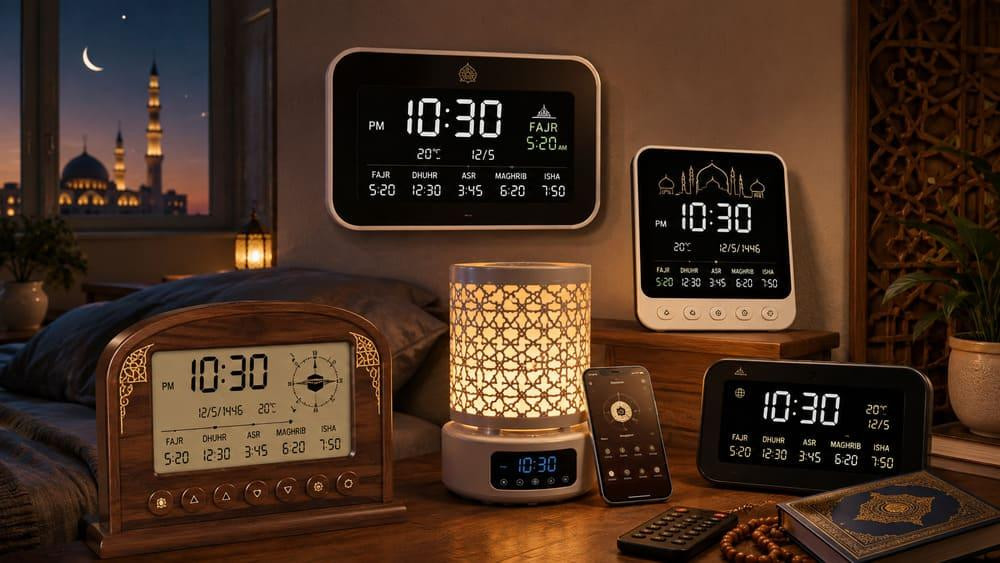
The Digital Adhan Automatic Alarm Wall-Clock was built around exactly this problem. It has a feature most people don't expect — the alarm adjusts itself relative to Fajr automatically, so if you set it for five minutes after the azan and Fajr shifts by a minute the next morning, the alarm shifts with it. No recalculating, no guessing. It covers 1,500 cities worldwide, and the full-screen display lights up enough to read in a dark room without needing to fumble for a lamp. This is the clock for the household that keeps meaning to fix Fajr and keeps not fixing it.
For the Person Who Wants the Full Azan, Not a Beep
Some households don't just want a wake-up cue. They want the actual sound of the call to prayer moving through the house five times a day — Fajr through Isha — the way it would in a home near a mosque.
The Islam Adhan Alarm Clock Digital plays a complete azan recitation for all five daily prayers, not a shortened chime. Setting it up is as simple as entering your city's international dialing code, and it tracks both the Hijri and Gregorian calendars side by side — useful for a household juggling two systems of dates without thinking about it. There's also a separate weekend alarm option, which matters more than it sounds; a Saturday Fajr schedule that's different from a Tuesday one is a small thing that makes daily use actually sustainable.
For the Person Who Travels or Just Moved
Prayer times change with your location, and figuring that out manually every time you land somewhere new — or move to a new city — is its own small, recurring headache. Most people either guess or default to whatever their phone app assumes, which isn't always accurate to where they actually are.
The Adhan Digital Prayer Clock handles this with a global taqweem system built specifically for resetting quickly by city, so the five daily alarms recalibrate without you doing the math. It's engineered for households, offices, and anywhere prayer needs to stay on schedule without someone checking an app every morning. If Ramadan or Eid is coming up and you're thinking about a gift that actually gets used daily instead of displayed once, this is the kind of clock that ends up on someone's nightstand for years, not their shelf.
For the Person Who Wants Function and a Little Elegance
Not every clock has to look purely utilitarian. Some people want their prayer clock to also feel like an intentional piece of the room — something with a bit of craft to it, not just a plastic box with buttons.
The Wooden Azan Clock with Qibla Compass covers both. It's a 2-in-1 design that works as a table clock or a wall clock, built with a Qibla compass and a Hijri calendar alongside the azan alarms — genuinely useful if you're setting up a prayer corner and don't already know your exact direction. The wood finish means it doesn't look out of place next to a bookshelf or a sajadah in the corner of a room, which matters more once the clock's been sitting there for a year.
For the Nightstand That's Already Too Crowded
Some households don't need another separate device. They need one thing that does more than one job, especially in a bedroom where the nightstand is already fighting for space between a lamp, a phone charger, and a glass of water.
The Decorative Table Lamp with Built-In Adhan Clock and Digital Quran Player solves that by combining three things into one — ambient lighting, prayer alarms, and a Quran speaker, all controlled through an app on your phone. It's the kind of gift that looks like it's just a lamp until someone realizes it's quietly reorganizing their entire prayer routine, one tap at a time. Good for a bedroom, a study corner, or a gift for someone setting up their first apartment.
Who Actually Needs One?
The household that keeps oversleeping Fajr wants the automatic wall clock — the one built specifically around that exact failure point.
The person who wants the full azan experience, five times a day wants the complete-recitation clock with the dual calendar.
The traveler or the recent mover wants the global city-setting clock that recalibrates fast.
The person setting up a proper prayer corner wants the wooden clock with the Qibla compass built in.
The person who wants one device instead of three wants the lamp-clock-Quran combination.
Most people only need one. A few end up wanting two — one for the bedroom, one for the kitchen or living room — because the habit that sticks is usually the one you can hear from wherever you actually are in the house.
A Few Questions People Actually Ask
Do digital adhan clocks work in any city, or only certain regions? Most models cover a large global city list and calculate prayer times automatically once you enter your location or dialing code — no manual research required.
Is the sound just a beep, or an actual azan recitation? The better ones play a complete azan recitation for each prayer, not a generic tone. Check the product description for "full azan" versus a shorter reminder chime if that distinction matters to you.
Can I use one of these instead of a prayer app? You can, and many people prefer it — a dedicated clock doesn't drain your phone battery overnight and doesn't rely on you remembering to open an app.
Do these clocks track the Hijri calendar too? Most of the clocks above display both Hijri and Gregorian dates, which is genuinely useful for tracking Islamic holidays and fasting days without cross-referencing a separate calendar.
Are these good gifts, or mainly for personal use? Both. They're one of the more practical Islamic gifts precisely because they get used daily rather than displayed once and forgotten.
Ordering From Madinah Mart
Finding a prayer clock that actually holds up — instead of a cheap import that stops recalculating prayer times after a few months — has been a recurring frustration for a lot of households. Madinah Mart ships across the US and Puerto Rico, and the adhan clock selection is chosen around actual daily use, not just novelty. You can see the full range on the Adhan Clocks and Speakers page, or check the best sellers if you want to see what other households are already relying on.
Back to That Missed Fajr
My father eventually gave in and got a clock — not because he wanted to, but because my mother bought one and put it on his side of the bed without asking. He complained about it for about a week. Then I noticed he stopped complaining, and stopped missing Fajr, at roughly the same time.
He never admitted the clock did what his willpower couldn't. He didn't have to. The habit was just there one day, quietly, the way habits actually build — not through discipline you conjure out of nowhere, but through removing the one small obstacle that kept getting in the way.
Browse the full collection at Madinah Mart.