How to Decorate Your Living Room with Islamic Style
My khala's living room in Giza had a smell before it had a look. Bakhour, mostly, the kind that gets into the curtains and stays there for days. I was maybe eleven the first time I really noticed the room itself and not just the smell — a carpet hanging on the far wall, woven with Ayat al-Kursi, catching the afternoon light in a way that made the gold threads look almost wet. Nobody had told her to put it there. She just had.
Years later, furnishing my own first apartment, I wanted that same feeling and had no idea how to get it. Every "Islamic decor" search pulled up either something that looked like a gift shop exploded across a wall, or nothing Islamic at all — just beige. There didn't seem to be a middle ground between too much and not enough, between a living room that says something about your deen and one that just says decorated.
That middle ground exists. Here's what actually fills it.
Why an Islamic Living Room Is Harder to Get Right Than It Looks
Most rooms don't have to hold two different jobs at once. A living room does — it has to be comfortable enough for a Tuesday evening and dignified enough for guests who show up unannounced after Maghrib, which in a lot of Muslim households, they do. Layer "Islamic" onto that and the difficulty compounds. You want the room to reflect faith without turning it into a themed space. You want calligraphy on the wall, not a slogan.
The instinct a lot of people have — mine included, that first apartment — is to over-correct. Buy five Allah-name pieces at once. Hang them all the same week. It ends up reading as anxious rather than intentional, like the room is trying to prove something. A living room that actually feels rooted in Islamic style gets there slower. One piece earns its wall. Then another, months later, earns its shelf. What follows is less a shopping list and more a sequence — the order things tend to matter in, if you're starting close to empty.
1. Start With the Wall That Faces the Door
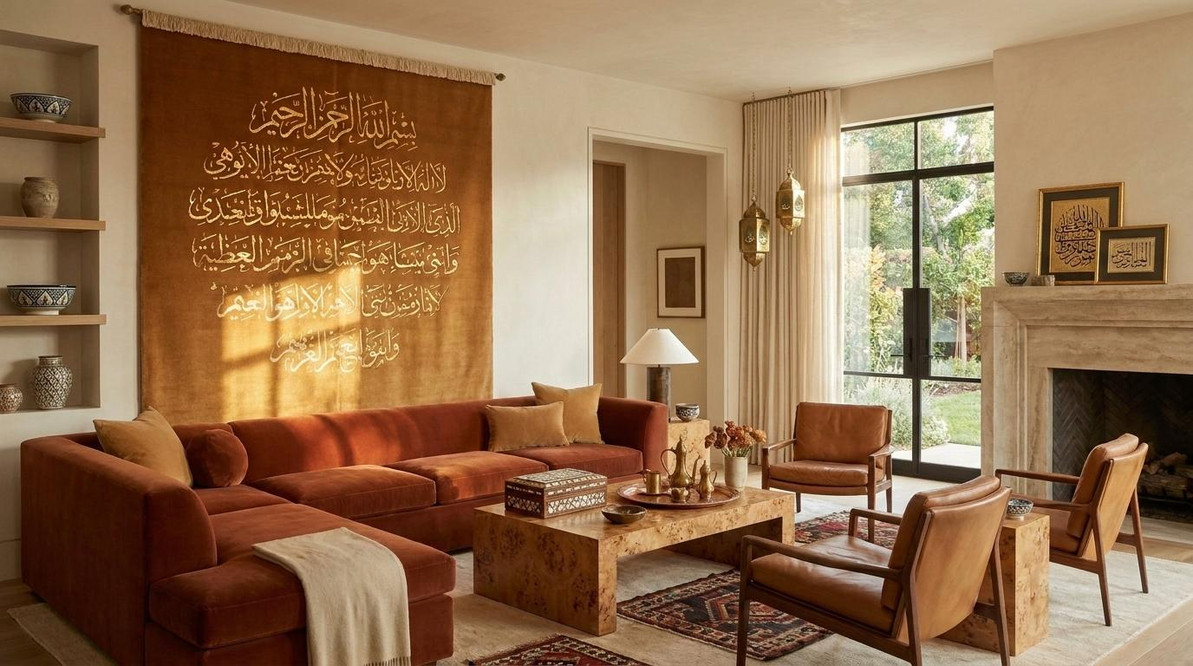
Whatever wall greets people when they walk in carries more weight than any other surface in the room. It sets the tone before anyone sits down. This is where a wall hanging works better than a small framed print — scale matters here, and a framed 8x10 gets lost.
The Elegant Handmade Carpet-Wall Hanging with Ayat al Kursi is Egyptian-made, embroidered rather than printed, which is a distinction you feel more than see — printed pieces go flat under lamplight, woven ones don't. It's close to what hung on my khala's wall, though hers had faded at the edges from decades of sun. Mine hasn't gotten there yet. Give it time.
2. Layer In Calligraphy That Isn't Just Decoration
Once the entry wall is settled, the rest of the room needs pieces that reward a second look rather than just filling space. Gold-toned calligraphy does something warm-toned rooms especially benefit from — it reflects lamp light instead of absorbing it, so the whole wall feels lit rather than just lined.
The Islamic Wall Art with Arabic Calligraphy in Golden Floral Design works well grouped with something smaller and quieter. For that, a Rustic Wooden Islamic Wall Decor Set with Bismillah, MashaAllah, and Alhamdulillah sits nicely underneath or beside the larger piece — three small words doing what a longer verse can't, which is remind you gently instead of announcing itself.
3. Give the Room a Reason to Glow After Dark
A living room built around bright overhead light stops feeling like a room and starts feeling like an office. Islamic-style spaces tend to lean on warmer, lower light — something you'd actually want to sit under during a late-night conversation with your mother on the phone.
The Allah Written LED Night Light does this from a side table or shelf corner. It's a 3D illusion lamp on a wood base, small enough — about 17 by 7 centimeters — that it doesn't compete with anything else in the room, and it runs on batteries, so it's not tethered to an outlet near a wall you'd rather leave bare.
4. Set Up a Corner That Isn't Just for Show
This will sound like a small detail to fuss over. It isn't. Every Muslim living room I've ever spent real time in has one corner that quietly does more work than the rest of the room combined — a spot where the Quran actually gets opened, not just displayed.
A Quran Holder Stand in Beech Wood, Inlaid with Mother of Pearl changes how that corner behaves. A Quran flat on a side table stays closed more often than it should. One propped open on a stand — foldable, so it packs away when you need the table for something else — gets picked up. The inlaid pearl detail, arranged in geometric patterns across the wood, is the kind of thing guests notice without saying anything, which is exactly the register a living room should operate in.
5. Bring the Prayer Corner Into the Same Room, Not a Separate One
Not every home has a spare room for salah. Most don't, honestly. The living room ends up doing double duty, and that's fine — it just needs a rug that can be rolled out and rolled back up without looking like an afterthought either way.
The Quilted Sajadah Prayer Rug is thick enough that it reads as furniture, not equipment, when it's folded in a corner. Woven in blue tones with a sheen that catches light the same way the wall hanging does, it doesn't clash with the rest of the room's palette the way a plain prayer mat sometimes can. Roll it out for Maghrib, roll it back, and the room hasn't changed character in between.
6. Handle Scent Like It's Part of the Decor, Because It Is
Nobody puts fragrance on a mood board, but it's doing more for how a room feels than half the furniture in it. My khala's living room smelled like bakhour before I understood what bakhour was. That's not incidental — it's basically the whole point.
A Golden Crescent Bakhoor Incense Burner does the job with enough visual weight to sit out on a coffee table between uses, crescent finial and all — it doesn't need to be hidden in a drawer when it's not lit. For something that needs zero setup on an ordinary Tuesday, a Rose & Oud Candle in a 10-ounce glass jar covers the same ground with less ceremony. Different occasions, same underlying instinct: the room should smell like it means something.
7. Let the Room Keep Time With You
Adhan on a phone is a notification you swipe away half-asleep. An adhan clock on the wall is something else entirely — it pulls you rather than pinging you, and in a living room where the family actually gathers, that difference matters more than it sounds like it should.
The Adhan Digital Prayer Clock covers all five daily prayers with a full recitation rather than a beep, sets by international dialing code so it's accurate to your actual city, and displays the Hijri date alongside the Gregorian one — a small thing that ends up mattering more than expected once Ramadan planning starts.
If You're Starting From Nothing
Not everyone is decorating a full living room at once. Some people are working with one bare wall in a first apartment and a budget that doesn't stretch much past that.
Start with light and scent before anything else. A night light and a candle cost less than a single wall hanging and do more to make a room feel occupied rather than furnished. The wall pieces can wait — they tend to mean more anyway when they arrive one at a time, the way my khala's probably did, rather than all in the same delivery box.
If there's a little more room to work with, the prayer rug earns its place next. It's the one item on this list that does something functional every single day, which makes it feel less like decor and more like a fixture of the house — the kind of thing that stops being noticed because it's simply there, doing its job, the way furniture is supposed to.
A Few Questions People Actually Ask
Does an Islamic-style living room have to include a prayer rug? No. Plenty of rooms lean entirely on wall art, lighting, and scent. A rug helps if salah regularly happens in that space, but it's not a requirement for the style to read clearly.
What's a mistake people make when they start decorating this way? Buying everything at once. A room filled in a single weekend usually looks assembled rather than lived-in. Spacing pieces out over months tends to look more intentional, almost by accident.
Is gold-toned calligraphy too much for a small living room? Not if it's one anchor piece rather than several competing ones. One gold wall hanging plus a smaller wooden set reads as layered. Three gold pieces in the same sightline reads as cluttered.
Can I mix Islamic decor with a more modern, minimalist style? Yes, and it often works better that way. A single carpet wall hanging against a plain wall carries more weight than the same piece surrounded by other patterned decor. Minimalism gives calligraphy room to actually be read.
Where should the Quran stand go if there's no dedicated prayer corner? Anywhere it'll get walked past daily — a console table by the entry, a shelf near the sofa. Visibility matters more than a fixed "correct" location.
Ordering From the US, Without the Overseas Wait
There used to be a real cost to wanting pieces like this — watching a tracking number crawl across an ocean for six weeks, hoping customs didn't hold it longer. Madinah Mart is US-based and ships across the US and Puerto Rico, and the selection is actually curated around Islamic tradition rather than being a general home decor catalog with a handful of Arabic-lettered items dropped in. Browse the full Islamic gifts and home decor collection or the best sellers if you'd rather see what other people are actually hanging on their walls first.
Browse the full collection at Madinah Mart.