8 Daily Sunnah Habits Every Muslim Can Start Today
My grandfather woke up before everyone else in the house. Not because he set an alarm — he never needed one — but because Fajr had some kind of hold on him that the rest of us didn't understand until much later. I remember the sound of the tap running in the bathroom before sunrise, the specific rhythm of it, three then three then three. I was maybe seven. I thought it was just what old men did.
It wasn't until years after he passed that I realized what I'd actually been listening to. It wasn't a routine. It was a whole life built out of small, repeated things — habits so quiet you'd miss them if you weren't paying attention, and so consistent that they eventually looked like character. Nobody sat me down and taught me the Sunnah as a list. I absorbed it from a man who never once called it that.
Here are eight of those habits, the ones worth starting today.
Why the Small Sunnahs Are Harder Than the Big Ones
Fasting Ramadan, going for Hajj, giving zakat — these have deadlines. Something in the calendar forces your hand. The daily Sunnah habits don't have that built-in urgency. Nobody's checking whether you said Bismillah before you ate breakfast. Nobody's tracking whether you smiled at the person who annoyed you at work. That's exactly what makes them slip.
The Prophet ﷺ said the most beloved deeds to Allah are the ones done consistently, even if small (Sahih al-Bukhari 6465). Not the biggest. The steadiest. Which is a strange thing to sit with, because most of us are wired to chase the big moment — the one dramatic act of worship — while the actual thing that shapes a person is what they do without thinking, every single day, for years.
That's the tension underneath this whole list. None of these habits are hard on their own. Keeping them up is the part nobody talks about.
1. Start the Day by Saying Bismillah
Before anything — before checking your phone, before coffee, before your feet hit the floor — saying Bismillah is the smallest possible act of remembrance, and also one of the most consistent ones a person can build. It reframes the day before the day has even started. You're not just waking up. You're waking up in Allah's name.
It sounds almost too small to count. It isn't. This is the kind of habit that anchors everything after it, and it costs you nothing.
2. Guard the Five Daily Prayers — Especially on Time

Salah on time, not just salah eventually, is one of the clearest markers of a life organized around faith rather than around convenience. My grandfather's Fajr wasn't impressive because he prayed it. It was impressive because he prayed it at its actual time, every day, regardless of how tired he was.
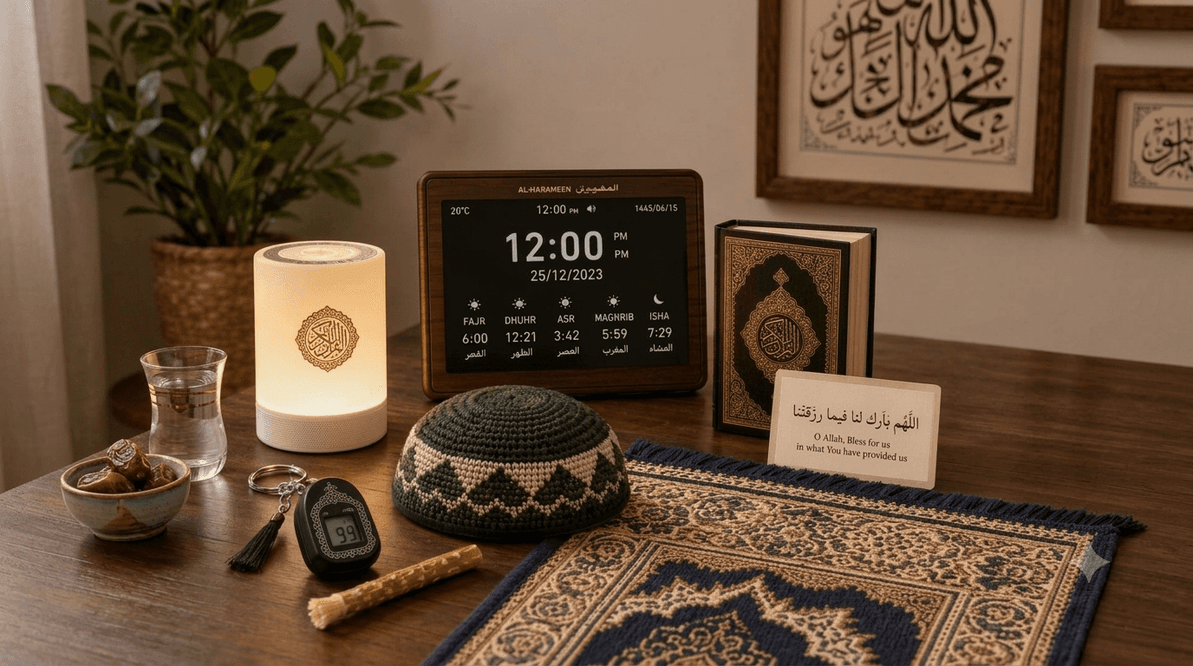
Most households I know have some version of the same problem — Dhuhr slides into the afternoon, Asr gets forgotten until the sun is nearly down. An Adhan Digital Prayer Clock solves the actual mechanism of that problem. It calls the full azan for all five prayers, adjusts automatically to your city, and sits on a shelf doing the one job a phone notification never quite does — pulling you, not just pinging you.
3. Recite Something From the Qur'an Every Day

Not a chapter. Not even a page, necessarily. Some tilawah, daily, is the Sunnah — a small amount recited consistently outperforms a long amount recited once a month and then abandoned out of guilt.
For a lot of households, this habit dies quietly because the Qur'an itself isn't within easy reach — it's on a shelf, in a drawer, somewhere that requires effort to get to. A Quran Speaker Touch Lamp removes that friction entirely. Touch it, and the recitation starts. No searching for the right surah, no juggling an app while your hands are full of something else. It just becomes part of the room the way a lamp is part of a room.
4. Use the Miswak, or at Least Care for Your Teeth With Intention
The Prophet ﷺ said that if it wasn't difficult for his Ummah, he would have commanded them to use the miswak before every prayer (Sahih al-Bukhari 887). That's not a small endorsement. This is one of the most repeated Sunnahs in the hadith literature, and one of the easiest to actually start today — you don't need permission, equipment, or planning. You need a stick of siwak and about ninety seconds.
Even if the miswak itself feels unfamiliar at first, the underlying habit — caring for your mouth and your breath before you stand in prayer — is worth building regardless of the exact tool.
5. Dress With a Sense of Modesty and Intention, Even at Home

Sunnah dressing isn't about looking a certain way in public. It's about carrying a kind of dignity even in private, even around your own family. For men, that has historically included some form of head covering during prayer and remembrance — not obligatory, but deeply rooted in how the earliest Muslims presented themselves before Allah.
A Handmade Cotton Crochet Turkish Kufi Cap does that quietly. It's not costume. It's the kind of thing you put on before Fajr without thinking twice, and somehow the prayer feels a little more deliberate because of it.
6. Make Du'a Before You Eat and After You Finish
"Allahumma barik lana fima razaqtana" before the meal. Alhamdulillah after. Two short lines, and yet they turn an ordinary act — eating — into something acknowledged rather than automatic. Most people eat dozens of times a week without a single moment of gratitude attached to any of it.
This one doesn't need a product. It needs a pause. That's the whole habit.
7. Smile — Genuinely, and Often
The Prophet ﷺ said that smiling at your brother is charity (Sunan al-Tirmidhi 1956). Of everything on this list, this might be the one most people skip without realizing it, because it doesn't feel like worship. It feels like nothing. That's the trick of it — the Sunnah habits that cost the least effort are often the ones we're least disciplined about.
No product fixes this one. Just the decision, repeated daily, to actually mean it.
8. Set Up a Space That's Actually Meant for Prayer

Most households have a version of a prayer space that's technically functional — a mat pulled out of a closet, unfolded on whatever patch of floor happens to be free. It works. It's also forgettable, and forgettable spaces make it easier to delay the prayer that belongs in them.
A Turkish Tassel Sajadah Prayer Rug, soft underfoot with real texture in the weave, changes that in a way that's hard to quantify but easy to feel. Salah on a rug that's actually pleasant to kneel on turns into something you look forward to instead of something you get through.
Which One Should You Actually Start With?
Ten habits is a lot to take on at once, and trying all ten simultaneously usually means none of them stick.
If your prayers are inconsistent, start with the Adhan clock — fix the mechanism before you worry about the rest. If your home feels spiritually quiet, start with the night light or the prayer rug — change the environment first and the habits tend to follow. If you're someone who's already praying on time but wants to deepen it, the Qur'an speaker and the dhikr habits are where the real work is.
Pick one. Not three, not all ten. One habit, kept for thirty days, does more for a person than a list of ten kept for three.
A Few Questions People Actually Ask
Do I have to do all ten to be a "good Muslim"? No. The Sunnah is a body of practice built over a lifetime, not a checklist to clear in a week. Consistency in even one or two of these matters more than attempting all ten and abandoning most of them within a month.
Is using a physical reminder like a night light or a keychain actually part of the Sunnah? The objects themselves aren't the Sunnah — the remembrance and the habit are. But there's nothing wrong with using a physical cue to support a spiritual habit, the same way people use a written note to remember an appointment.
What if I miss a day? You start again the next day. The Prophet ﷺ specifically praised the deeds done consistently over time, not the unbroken streak. A missed day isn't a failure. Quitting entirely is the only real failure here.
Where do I even begin if none of this feels natural yet? Bismillah before eating and Alhamdulillah after. That's the entire starting point. Everything else can build from there.
Can children start these habits too? Yes, and earlier than most parents assume. Du'a before meals and the habit of saying Bismillah are both things a four or five year old can pick up simply by watching it modeled consistently at home.
Where to Actually Find These
Ordering Islamic goods used to mean waiting on something shipped across an ocean, watching a tracking number crawl for three weeks and hoping it survives customs. Madinah Mart is based in the US and ships across the US and Puerto Rico, and the selection is curated specifically around Islamic practice rather than being a general gift shop with a small Islamic corner tacked on. If any of the habits above are missing a piece from your home, the Islamic Gifts collection is the place to start looking.
Coming Back to the Beginning
My grandfather never explained any of this to me directly. I pieced it together afterward — the miswak by the sink, the same worn prayer mat in the same corner, the way he'd murmur something under his breath before every meal that I assumed for years was just an old habit rather than an actual du'a.
What I didn't know until much later: that mat wasn't the same one his whole life. My mother told me he replaced it exactly once, sometime in his sixties, and complained for a week that the new one didn't feel right underfoot until it did.
That's the thing about these habits. They're not dramatic. Nobody writes a khutbah about saying Bismillah before breakfast. But add them up over forty years and they become the outline of a person — the thing his grandchildren remember, decades later, standing in a bathroom listening to a tap run before Fajr.
Start with one. Keep it for thirty days. See who you become.
Browse the full Islamic Gifts collection at Madinah Mart.