Best Islamic Toys and Games for Muslim Children: What Actually Gets Played With
My cousin Ibrahim was five the first time I watched him ignore an iPad for twenty straight minutes. That was notable. Every other visit to my aunt's house started the same way — the kids scattered across the couches, screens up, the room gone quiet in that particular way screens make a room quiet. But that Friday, my uncle had brought back a small wooden puzzle from a trip to Madinah, the outline of the Prophet's Mosque cut into thick painted pieces, and Ibrahim sat cross-legged on the floor fitting it together, muttering the names of the minarets to himself like he already knew them.
Finding a toy like that one is harder than it should be. Search "Islamic toys" and you mostly get plastic prayer mats with a cartoon mosque printed on them, or Arabic alphabet sets that teach the shapes of letters with no real connection to what those letters spell. The deen ends up decorative. Present on the packaging, absent from the actual play.
Here are eight that don't do that.
Why the Right Islamic Toy Is Harder to Find Than It Looks
Most toy aisles treat "Islamic" as a sticker you add to a generic product — a moon shape here, an Arabic word there — rather than something built into how the toy works. Parents notice. My aunt has said more than once that she can tell within a week which toys her kids actually pick up again and which ones get buried under the couch cushions. The difference usually comes down to whether the Islamic content is the point of the game or an afterthought stapled onto it.
There's also a quieter problem. A lot of Muslim parents in the US are raising kids without grandparents nearby, without the extended family that used to hand this knowledge down through sheer proximity. A toy can't replace that. But a good one can do some of the work — teaching Arabic letters through actual play, or turning the names of the Haramain into something a child holds in their hands instead of something they're told to memorize.
1. A Puzzle of the Two Holy Mosques

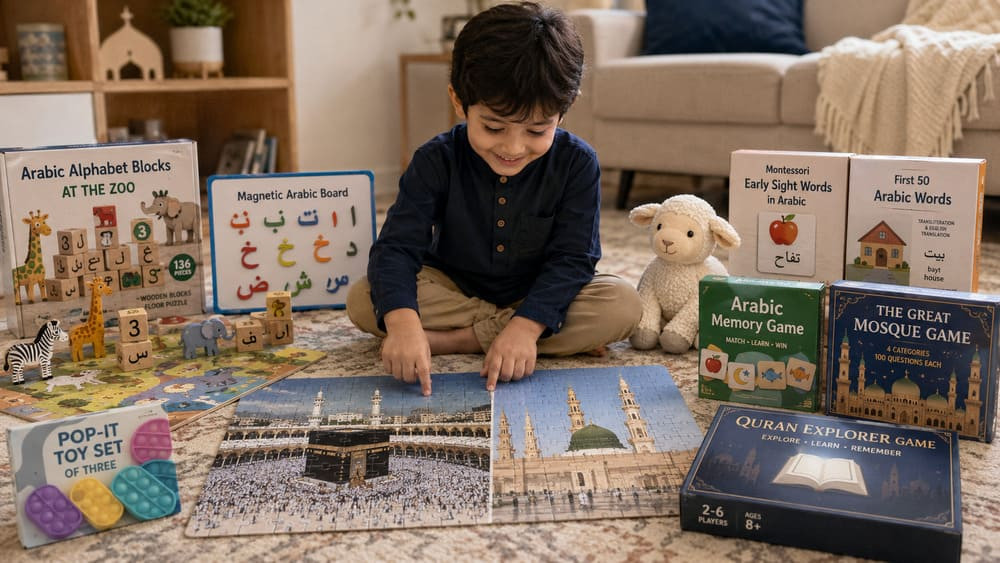
Most kids' puzzle boxes show farm animals or cartoon trucks. Nothing wrong with that, except it means a Muslim child can spend years assembling puzzles that have nothing to do with the two places that matter most in their family's story. Furqaan Puzzles fixes that gap directly. The Haramain Series renders Masjid an-Nabawi and the Masjid al-Haram in the kind of detail a real jigsaw needs — the courtyards, the domes, the crowds around the Ka'bah rendered small enough that a child has to actually look to find the pieces that fit. It's Egyptian-produced, sturdy enough to survive being dropped mid-assembly (it will be), and it does something most puzzles don't: it gives a child a mental picture of Makkah and Madinah before they've ever set foot there. For a household saving up for Hajj or Umrah one day, that's not a small thing.
2. Wooden Blocks That Do More Than Sit in a Bin

Every household with small children ends up with a bin of blocks somewhere. Usually plain, usually plastic, usually ignored after the first few weeks. Arabic Alphabet Blocks at the Zoo is 136 pieces — Arabic letter cubes, number blocks, animal shapes, and a 36-piece jumbo floor puzzle — and it earns more attention than a standard block set because there's always a next thing to do with it. Stack the letters, sort the animals, lay out the floor puzzle on a Friday afternoon while dinner is cooking. The wood has weight to it, not the hollow plastic click most toy bins are full of. It's built for the stage before a child can hold a pencil properly, which is exactly the stage when Arabic letters need to start feeling familiar rather than foreign.
3. A Board for Letters Before They're Ready for a Pencil

There's a specific frustration every parent teaching Arabic runs into: the child recognizes a letter on a flashcard, then can't reproduce it, and gets discouraged before the lesson even really starts. The Magnetic Arabic Board sidesteps that. Twenty-eight multicolored magnetic letters, a board they snap onto, no pencil required. A child spells out a word by moving pieces around rather than drawing shapes their hand isn't ready for yet. It sounds like a small distinction. It isn't — it's the difference between a lesson that ends in a meltdown and one that ends in a kid proudly spelling their own name in Arabic on the fridge.
4. Flashcards a Toddler Will Actually Reach For
Flashcards have a reputation problem. Most kids treat them the way they treat homework — something to get through, not something to choose. The Montessori Early Sight Words in Arabic set is different mostly because of what's on the back. Twenty-eight double-sided cards, a letter on one side, a bright, specific illustration on the other — bold enough colors that a toddler grabs for the deck the way they'd grab for a picture book. Pair it with First 50 Arabic Words once the alphabet has settled in, which layers in transliteration and English translation on the same card, and a toddler ends up building real vocabulary without ever sitting down for what feels like a lesson.
5. A Memory Game That Doesn't Feel Like a Worksheet
Every Muslim household with school-age kids eventually needs something to fill a rainy afternoon that isn't a screen. The Arabic Memory Game works the way memory games are supposed to — flip two tiles, find a match, whoever collects the most illustrated pairs wins — except every tile is teaching Arabic vocabulary while it's at it. Two or more players, fast rounds, genuine competition between siblings. This will sound like a low-effort recommendation, just a matching game. It isn't. Repetition is most of how language sticks for young children, and a memory game is repetition wearing a costume good enough that nobody complains about it.
6. Trivia Night, Except It's the Seerah of the Masajid
Once kids are old enough for real trivia — eight, nine, up through the teenage years when they'll actually argue about a correct answer — The Great Mosque Game earns a spot at the table. Four categories, a hundred questions each, covering the architecture and history of the world's most significant mosques: the Ka'bah, Masjid al-Aqsa, the great mosques of Makkah and Madinah. Illustrated question cards make it playable even for kids who aren't strong readers yet. It's built for family game night, not a classroom, which matters — a child who'd never sit through a lecture on Islamic history will happily argue with their older brother over which mosque has which minaret.
7. A Family Game Built Entirely on the Quran
For kids around eight and up, the Quran Explorer Game plays like any other family board game — two to six players, turns, a winner at the end — except every question comes from the Quran itself. Not Islamic trivia adjacent to the Quran. The Quran directly. It's the kind of game that turns into forty-five minutes at the dinner table longer than anyone planned, parents included, because someone gets a question wrong and the whole table wants to look up the ayah to check.
8. Something Soft for the Youngest One in the Room
Not every toy on this list needs to teach a letter. Sometimes the youngest kid in the house just needs something to hold. The Plush Toy Lamb Stuffed Animal is eco-friendly knitted cotton yarn, soft enough for a toddler's grip, and it carries an association a lot of Muslim families already have built in — the lamb, the Qurbani, Eid al-Adha. It's not trying to teach anything. It's just there for naps and car rides and the moments a small child needs something soft more than they need a lesson. Every list like this needs one toy that's simply comfort, and this is the one.
Who Are You Shopping For?
A toddler, eighteen months to three years. Skip anything with small pieces that could end up in a mouth. The Plush Toy Lamb works here, and so does the Pop-it Toy Set of Three for pure sensory play — no Islamic content, just something for small hands that need to fidget.
A preschooler, three to five. This is the sweet spot for the Alphabet Blocks, the Magnetic Board, and the Montessori flashcards. Their hands are ready for manipulation but not yet ready for a pencil, and all three lean into that.
An early reader, six to eight. The Furqaan Puzzles and the Arabic Memory Game both work here — enough complexity to hold attention, not so much that a child gets frustrated and walks away.
The whole family, game night. The Great Mosque Game and the Quran Explorer Game were built for this. Buy one, not both, unless the family genuinely plays board games often — the categories overlap more than the boxes suggest.
A cousin, a neighbor's kid, someone you don't know that well. Go with the puzzle or the flashcards. Both are specific enough to feel thoughtful, general enough to fit almost any household.
A Few Questions People Actually Ask
What age should a child start learning Arabic through toys?
Around eighteen months to two years is early enough to start with shapes and sounds, using blocks or magnetic letters rather than anything requiring fine motor control. Formal flashcard drilling can wait until three or four.
Are these toys only useful for kids being raised bilingual?
No. Most of these were designed for children growing up in English-speaking households with limited daily Arabic exposure. That's actually the harder use case, and it's the one these toys are built around.
Do the trivia games work for kids who aren't strong readers yet?
The Great Mosque Game and Quran Explorer Game both use illustrated cards, which helps. Full independent play usually works best from age eight up, though younger siblings can join in with a parent reading questions aloud.
Is it okay to give a puzzle as a gift instead of a toy that "teaches" something?
Yes. The Furqaan Puzzles teach through geography and visual memory without ever feeling like a lesson, which is often more effective than a toy that announces its purpose on the box.
How many of these does one household actually need?
Fewer than you'd think. One puzzle, one alphabet toy for the youngest child, one family game — that covers most of what a household actually plays with regularly. A shelf full of half-used toys teaches less than three that get picked up every week.
Where to Buy
There used to be a real hassle to this — ordering an Islamic toy from overseas, watching a tracking number crawl across an ocean for six weeks, hoping it survived customs intact. Madinah Mart is US-based and ships across the US and Puerto Rico, so that particular headache is gone. The selection is also curated specifically around Islamic tradition rather than being a general toy marketplace with a crescent-moon filter thrown over it — worth something if you've ever scrolled through a generic search result trying to tell which "Islamic" toy was actually made with any thought behind it. The full Toys & Games collection covers everything above and more, organized by Puzzles, Flashcards, and Dolls & Stuffed Animals.
Ibrahim's Puzzle, Finished
Ibrahim finished that puzzle of the two Haramain in about forty minutes, which for a five-year-old is closer to an act of will than a game. My uncle hadn't planned it as a lesson. He said later he just grabbed it at a shop near the mosque because it was small enough to fit in his suitcase — he wasn't thinking about teaching anyone anything, he just liked how it looked.
That's usually how the good ones work. Nobody sets out to raise a five-year-old who can name the minarets of Masjid an-Nabawi from memory. It happens because the right object was sitting on the floor at the right moment, and a kid picked it up instead of a screen.
Browse the full collection at Madinah Mart.