The Benefits of Listening to Quran Throughout the Day
My grandmother kept a small radio on top of the fridge. Not for music — I never once heard music come out of that thing. It was tuned, permanently, to a station that played Quran recitation on a loop, and it stayed on from Fajr until she went to bed. I was maybe seven the first time I asked her why she didn't just turn it off when she left the kitchen. She looked at me like I'd asked something slightly absurd. "Why would I turn off the Quran?"
I didn't understand the answer then. I do now, mostly because I've spent the last few years without that sound in my own house and I've felt the absence of it more than I expected to. Life gets loud in a different way when you're an adult — notifications, traffic, three conversations happening in different rooms — and somewhere in that noise, the recitation that used to just exist in the background of a Muslim home has quietly gone missing.
This isn't really an article about apps or playlists, though those things come up. It's about what actually changes in a household when Quran becomes ambient again — not a task you schedule, but a sound that's just there, the way it was on top of my grandmother's fridge.
It's Not "Background Noise" — That's the Wrong Way to Think About It
People sometimes feel a little guilty admitting they have the Quran playing while they cook, or drive, or fold laundry, like it doesn't count unless you're sitting still with a mushaf open and your full attention on the page. That guilt is misplaced, and honestly it keeps a lot of people from doing something that would genuinely help them.
Listening isn't a lesser form of engagement. The Prophet ﷺ himself asked to be recited to and wept while listening, not reciting. Tilawah reaching your ears while your hands are busy elsewhere still counts as remembrance of Allah — dhikr doesn't require your body to be still, only your heart to be somewhat present. A kitchen with the Quran playing during dinner prep is a different kind of room than a silent one, even if nobody's technically "praying."
What changes isn't dramatic. It's cumulative. Ayat that would otherwise take years to memorize start sitting in a child's ear just from repetition. A stressful afternoon softens slightly when Surah Ar-Rahman is playing instead of nothing. The five daily prayers stop feeling like interruptions to the day and start feeling like the day's actual shape, because something is already threading through it.
A House That Sounds Like Something
Most homes, even practicing ones, default to silence or the TV. Nobody decided this on purpose — it's just what fills the gap when nothing else is playing. The problem is that silence isn't neutral. It's its own kind of atmosphere, and it's not usually the one people actually want.
The 3D Moon Quran Speaker Night Light solves this in a way that doesn't feel like a chore. It's small — sits on a shelf or a nightstand — and it glows like an actual crescent moon while it plays recitation from any of several reciters through Bluetooth or its own app. You're not opening a browser tab and hoping the ads don't autoplay something else. You touch it, it lights up, it plays. My cousin keeps hers in the living room and says her kids started asking for "moon time" instead of screen time, which is the kind of trade nobody expects to actually work until it does.
Kids Absorb What's Around Them, Not What You Teach Them
Here's the part that surprised me most researching this. You can sit a child down for twenty minutes of formal Quran study and they'll retain a fraction of it. Play the same surah quietly in the background of their play for a week and they'll start humming the tune without being asked to memorize anything. This isn't a shortcut around actual learning — it's the groundwork that makes actual learning faster later.
A speaker in the playroom or the car does more of this work than most parents give it credit for. The Quran Speaker Touch Lamp with App and Remote Control is built with exactly this kind of casual, all-day use in mind — 21 reciters, translation in over two dozen languages, and a touch-sensitive lamp function so it doubles as a nightlight once the recitation's done for the day. It's not marketed as an educational tool, which is honestly part of why it works as one. Nobody resents a lamp.
Prayer Times Stop Slipping Past You
This is the more practical benefit, and it's the one people usually notice first even though it's not really about "listening" in the reflective sense. When the adhan is baked into your environment instead of buried in a phone notification you swipe away without reading, you stop missing prayers by accident. Not because you're more disciplined. Because the house itself reminds you.
The Adhan Digital Prayer Clock calls all five prayers with a full recitation, not a beep, and sits on a counter or desk the way a normal clock would — except this one is actually doing something for you five times a day. For a wall-mounted option, the Digital Adhan Automatic Alarm Wall-Clock does the same job from up higher, which matters more than it sounds like it should in a house where counter space is already fought over.
There's a difference between an adhan you chose to hear and an adhan you happened to hear while doing something else entirely. Both count. The second one is just harder to ignore.
A Corner That Actually Gets Used
Every household I've ever visited has one of these — a Quran that lives somewhere, usually flat on a shelf or a nightstand, closed. Not neglected exactly. Just not open. The gap between owning a mushaf and actually reading from it regularly is wider than people admit, and most of that gap comes down to friction. Flat and closed means you have to decide to open it. Upright and visible means it's already halfway there.
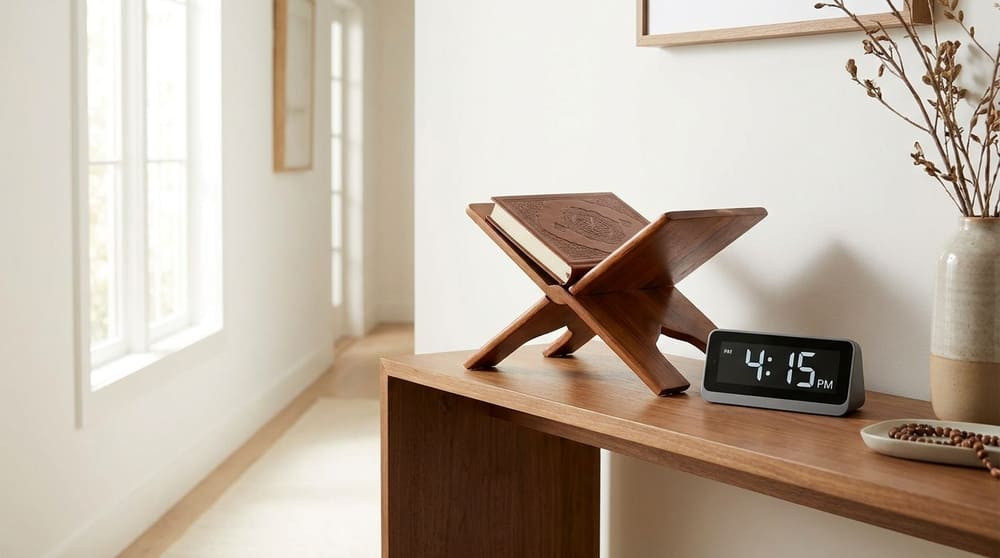
The Wooden Quran Stand is a small fix for a problem that's mostly psychological. Cherrywood finish, carved detail, and it folds flat for storage when you're not using it — but set up on a desk or a prayer corner, it turns the Quran from an object you own into an object you're actually looking at. Pair that visual cue with a speaker already playing somewhere nearby and the whole corner starts pulling double duty: recitation in the air, the mushaf standing open and ready if the sound moves you to actually read.
Difficult Moments Need Something to Hold Onto
Nobody talks about this part enough. There's a specific kind of night — a bad diagnosis, a fight nobody's over yet, a kid who won't sleep and won't say why — where silence makes everything worse. The mind fills silence with whatever it's already anxious about. Recitation, even quiet and low in the background, gives the mind somewhere else to land.
A bedside option like the Square Cube Portable Bluetooth Quran Player works well here specifically because it's small enough to not feel clinical, sitting on a nightstand the way a regular speaker would, with soft LED light and enough reciters loaded in that you can find whichever voice actually settles you. This isn't a claim that it fixes anything. It's smaller than that. It just gives a hard night something to hold onto besides the dark.
Who Actually Benefits From This
New parents. The window between newborn and toddler is loud with everything except the things you meant to prioritize. A speaker doing the work passively is realistically the only version of "Islamic environment" that survives sleep deprivation.
Reverts and people rebuilding their practice. Familiarity with tilawah takes time to build, and it builds faster through repeated exposure than through forced study sessions. Ambient listening removes the pressure of "doing it right."
Working parents with long commutes. The car is already dead time. A phone connected to Bluetooth turns forty minutes of traffic into forty minutes that weren't wasted, even if nobody in the car is technically paying attention the whole time.
Grandparents and older family members. Reading small print gets harder with age; listening doesn't. A speaker in a kitchen or a bedroom keeps someone connected to daily recitation long after reading comfortably stops being realistic.
Anyone rebuilding a habit that slipped. Not everyone who wants more Quran in their life wants to start with a study plan. Some people just want the sound back in the house first. That's a legitimate starting point, not a lesser one.
A Few Questions People Actually Ask
Does listening to Quran without understanding Arabic still count as worship? Yes. Reward is tied to sincerity and remembrance, not comprehension level, though pairing recitation with translation — most of these speakers include it — deepens the benefit over time.
Can I play Quran recitation while doing everyday tasks like cooking or cleaning? Yes, and scholars have generally encouraged exactly this kind of ambient listening as a low-effort way to keep dhikr present throughout an ordinary day.
Is it disrespectful to have the Quran playing at a low volume in the background? No, as long as it's treated with basic respect — not muted mid-verse for something trivial, not played over inappropriate content. Low volume during work or study is fine.
What's the difference between a Quran speaker and just using a phone app? Mainly consistency and intention. A dedicated speaker doesn't buzz with unrelated notifications and doesn't tempt you to switch to something else mid-surah the way a phone screen does.
How do I get my kids interested in listening without forcing it? Make it ambient rather than assigned. A speaker in the playroom during unstructured play does more than a scheduled "Quran time" that starts to feel like homework.
Ordering This Kind of Thing Shouldn't Be Complicated
There used to be a real annoyance to this — ordering a Quran speaker from an overseas seller and watching the tracking number sit still for three weeks. Madinah Mart is US-based and ships across the US and Puerto Rico, and the selection is curated specifically around Islamic home and prayer life rather than a general marketplace with an "Islamic" tag slapped onto random imports. If you're looking to browse further, the full Quran Speakers collection and Best Sellers are both worth a look.
Back to the Fridge
I bought my own version of my grandmother's radio a few months ago — not literally, obviously; hers was an actual AM/FM box with a bent antenna and a dial that stuck. Mine is one of the small Bluetooth speakers, sitting on the kitchen counter, playing whatever surah I last had queued up. My daughter, three years old, has started calling it "the Quran box" without anyone teaching her that name. She made it up herself.
I don't know if my grandmother ever thought about what that radio was doing to the people who grew up in that kitchen. I doubt it was a conscious strategy. It was just on, the way the lights were on, the way the stove was on when she cooked. But I remember the sound of it more clearly than I remember most of what she actually said to me, and that has to mean something.
The house doesn't have to be silent. It really doesn't take much to change that.
Browse the full Quran speaker and Islamic home collection at Madinah Mart.