A Beginner's Guide to Building Your First Prayer Corner at Home
My aunt Faiza came to see my first apartment two weeks after I moved in. She walked through the living room, said the right things about the kitchen, admired the view from the balcony — and then she stopped by the window in the corner and just looked at it. Empty. A phone charger cord coiled on the floor where a lamp should've been.
She didn't say anything about the corner. She didn't have to. I'd been praying on a towel folded twice, in whatever direction felt roughly right, for two weeks straight, and somehow that folded towel had become the loudest, most obvious thing in the entire apartment.
Setting up a real prayer corner isn't complicated. It just takes deciding, on purpose, that the corner matters. Here's how to actually do it.
Why the Corner Matters More Than It Should
Salah doesn't need a special room. The Prophet ﷺ said the whole earth has been made a place of prayer for us — a fact every Muslim knows and every Muslim, at some point, uses as an excuse to keep praying on whatever surface happens to be closest. Technically fine. Practically, it means five prayers a day happen in five slightly different, slightly distracted spots, and khushu — that focus, that presence — keeps getting interrupted by logistics. Where's the rug. Which way is qibla, again. Is that the TV remote under my knee.
A dedicated corner removes the logistics. You walk over, you already know the direction, the rug is already there, and your mind gets to skip straight to the prayer instead of the setup. That's really the entire argument for having one. Not aesthetics. Fewer decisions between you and Allah.
Start With the Qibla, Not the Décor
Before anything gets bought or arranged, find your qibla direction and mark it. A compass app works, most Muslim prayer apps have one built in, and once you know the angle, you don't need to re-check it every day — just remember it, or mark the wall lightly with tape until the rug placement makes it obvious on its own.
This step gets skipped constantly because it isn't fun. Everyone wants to jump to the rug and the wall art. But an achingly beautiful corner facing forty degrees off qibla is still a corner facing the wrong direction. Get this right first, then build.
A Rug Worth Kneeling On

Most people have a prayer rug that's technically fine. Thin, a little worn, rolled in a corner somewhere between prayers because it doesn't really belong anywhere. Functional. Forgettable. The kind of rug you don't think about at all, which is exactly the problem — you want your knees to stop noticing the floor, not remind you of it mid-sajdah.
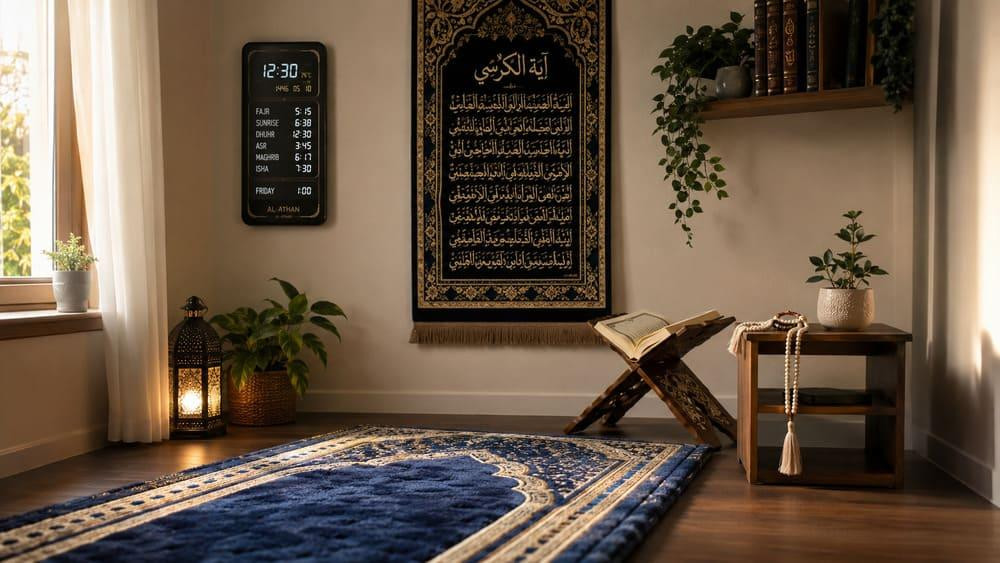
The Islamic Luxury Padded Sajjadah solves the actual physical problem — it's thick, cushioned, and grips the floor instead of sliding every time you stand up too fast for Fajr. It's not decorative first. It's built to be knelt on for years, which, if you think about how many times a prayer rug touches the ground in a single week, is the entire point.
Something on the Wall That Isn't Just Decoration

A prayer corner with nothing on the wall in front of it works. It's just easier to lose focus in it. Something visual — a verse, a reminder — gives your eyes somewhere to rest that isn't the ceiling fan or a crack in the paint.
The Elegant Handmade Carpet-Wall Hanging with Ayat al Kursi is Egyptian-made, woven rather than printed, which matters more than it sounds — printed pieces fade and flatten, woven ones age the way a good rug ages, gaining a bit of character instead of losing color. Hung at eye level, roughly where your gaze naturally lands during standing, it turns a blank wall into part of the actual prayer instead of just the backdrop for it.
A Quran Stand That Actually Gets Used

There's a small, specific difference between a Quran that sits flat on a shelf and one that sits open on a stand, and it isn't aesthetic. Flat means closed most of the time. On a stand, at the right height, in the corner you already walk to five times a day — it gets opened. Not because you tried harder to read it, but because the friction of picking it up, finding a flat surface, and balancing it disappeared.
The Quran Holder/Stand in Beech Wood Inlaid with Mother of Pearl folds into an X-shape for storage but holds its shape solidly once open, with the pearl inlay catching light in a way that photographs never quite capture. It's a small object. It changes a surprising amount about whether tilawah actually happens after Isha or just gets postponed again.
A Tasbih Within Reach

Dhikr after salah is easy to skip when there's nothing physically there prompting you to do it. Counting on your fingers works — the Companions did exactly that — but a tasbih sitting in the corner, within arm's reach, removes the last small excuse.
A Handmade Sibha with smooth, pearl-style beads has a specific weight to it, the kind you feel settle into your palm after the first few counts. Thirty-three beads, worn down between thumb and forefinger a thousand times over — that's the whole design brief, and it does exactly what it needs to and nothing more.
The Adhan Clock — Small Thing, Big Difference

Phones buzz. Notifications get dismissed, swiped away half-consciously, folded into the general noise of a phone screen that's also showing texts and app badges. An adhan that comes from your phone competes with everything else your phone does. An adhan that comes from a dedicated clock in the corner doesn't compete with anything — it's just the sound the room makes five times a day.
The Digital Adhan Automatic Alarm Wall-Clock calculates prayer times automatically and calls the adhan on its own, with a separate Fajr alarm feature that's genuinely useful for anyone who's ever slept through the earliest prayer more times than they'd like to admit. Mounted near the corner, it becomes the household's actual clock — the one everyone glances at, not just the person praying.
If Kids Will Pray There Too

A prayer corner built only for an adult's height and pace tends to feel foreign to a small child standing next to it. If kids are going to learn salah in this same space — and for most families, they will — it helps to give them something that's genuinely theirs within it, not just a smaller version of yours.
The Interactive Coloring Prayer Rug comes with washable markers and seven black-and-white designs a child colors in themselves, which sounds like a minor detail until you watch a five-year-old choose their own rug pattern and then actually want to stand on it for Maghrib. It washes out and gets recolored, so it isn't a one-time craft project — it's a rug they keep returning to, on purpose, which is most of what you actually want at that age.
Who Are You Setting This Corner Up For?
A first apartment or a first rental. Keep it simple and portable — a padded rug, a wall hanging that doesn't need permanent nails, and a tasbih. Nothing here needs to survive a move badly.
A family home with young kids. Budget for two rugs, not one — an adult sajjadah and a kids' interactive one — plus an adhan clock loud enough for the whole house to hear, not just the corner.
Someone building a lifelong habit. This is where the Quran stand earns its place. A stand at the right height, in a corner used daily, quietly removes the friction between intention and action — which, for most people, is the entire battle.
A shared or guest-friendly space. Keep decor understated and universal — an Ayat al Kursi wall hanging works in almost any room, for almost any guest, without needing explanation.
A Few Questions People Actually Ask
How do I find the qibla direction without a compass?
Most prayer apps calculate it automatically using your phone's GPS. If you don't trust the app, ask your local masjid — most can tell you the exact direction from any address in minutes.
Does the corner need to be permanent?
No. A rug that rolls up and a wall hanging without nails work fine in a rental. What matters is that the same spot gets used consistently, not that it's bolted down.
Can I set one up in a small apartment or dorm room?
Yes — a folded rug and a small stand take up less space than a nightstand. Corner space next to a window or a quiet wall is usually enough.
What's the actual minimum I need to start?
A rug facing qibla. That's it. Everything else — the wall art, the stand, the clock — makes the habit easier to keep, but the rug and the direction are the only non-negotiables.
Should kids have their own rug, or share the adult one?
Either works, but a rug that's visibly theirs tends to get more consistent use from younger children, since it removes any friction about whose turn it is or where they're supposed to stand.
Ordering From Outside the US Used to Be the Real Obstacle
For a long time, the hardest part of building a proper prayer corner wasn't finding the right pieces — it was the shipping. Watching a tracking number crawl across an ocean for six weeks, hoping the rug that looked woven in the photos wasn't actually printed once it arrived. Madinah Mart ships from within the US, across the US and Puerto Rico, and the selection is genuinely curated around Islamic tradition rather than being a general home goods store with an "Islamic" filter switched on. What you see is closer to what actually shows up.
Back to That Empty Corner
I ended up asking my aunt, a few weeks later, what she'd done for her own first prayer corner, decades earlier, in a small apartment with my uncle. She said she hadn't done anything special — just a rug her mother had given her, facing a wall she'd guessed the direction of using the sun, adjusted properly once she found a compass a month later. She still has that rug. It's thinner now than it was then, patched once along one edge, and she still won't get rid of it.
That's the thing about a prayer corner. It doesn't need to be complete on day one. It needs a rug, a direction, and the decision to keep showing up to that exact spot until showing up there stops feeling like a decision at all.
Browse prayer essentials and more at Madinah Mart.