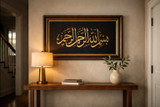

How to Choose Islamic Wall Art That Actually Feels Right in Your Home
Most people get Islamic wall art wrong the first time. Not because they don't care — obviously they do — but because they pick something that looks fine in the store or in a product photo and then get it home and it just... sits there. No presence. No feeling.
The pieces that work are the ones chosen with some intention. What does this room need? What verse or name do I actually want to see every day? Where is it going to hang and will people notice it there?
This isn't a complicated process but it is worth thinking through, so here's a practical breakdown — types of islamic wall art, where to put them, what works in American Muslim homes specifically, and some actual products worth considering.
Arabic Calligraphy: The Core of Islamic Wall Decor
The complete Arabic calligraphy art form requires a book because of its various scripts and its master artists, and its deep historical craftsmanship, which developed across many years. The most important aspect for home decorators to understand is that Quranic calligraphy represents the most important wall decoration that any person can choose to display.
Not because you have to. Because when you sit across from Ayat al-Kursi every morning, or glance up at Bismillah before you leave the house, something small but real happens. It's not decoration doing that. It's the words.
Ayat al-Kursi
It's the most hung verse in Muslim homes worldwide and it earns that status. Ayat al-Kursi is protective, it's majestic, and calligraphically it's one of the most beautiful passages in the Quran to render in script. If you only ever buy one piece of islamic wall art, this is the one.
The Handmade Carpet Wall Hanging with Ayat al-Kursi is worth looking at closely. It's Egyptian-made, embroidered — not printed — and it has the texture and weight of something that was actually made by hand. That matters. You can feel the difference when you hold it.
Surah Yasin
A lot of families grow up with Surah Yasin somewhere on the walls. It's read at gatherings, during illness, for the deceased — it carries a specific emotional weight that other surahs don't quite replicate. Having it on the wall is less about decor and more about keeping that presence in the house.
The Surah Yasin Velvet Fabric Poster is embroidered on rich velvet — deep colors, real craft. It photographs beautifully but more importantly it looks genuinely good on the wall, not cheap.
Allah and Muhammad ﷺ Together
Pairing the name of Allah سُبْحَانَهُ وَتَعَالَى with the name of the Prophet ﷺ is one of the oldest arrangements in Islamic wall decor. You see it over doorways in Syria, in Egyptian homes, in Turkish mosques. It belongs everywhere.
The Allah & Muhammad ﷺ Kite-Shaped Tapestry Set is a two-piece set — 17×12 inches each — and it works especially well flanking a doorway or on either side of a hallway. Bold without being heavy.
Beyond Calligraphy: Other Islamic Wall Art Worth Knowing
Wooden Carved and Laser-Cut Pieces
Wood brings something to a room that fabric and paper don't. It's warmer, it's permanent-feeling, and in the right finish it reads as contemporary rather than traditional — which matters if you're working with a modern interior.
The Arabic Calligraphy Wooden Pediment Signs have the du'as for entering and leaving the home carved into farmhouse-style wood boards. They go above or beside the front door and they serve a real function — not just decorative, but a daily reminder every time you come and go.
If you want something with a glow, the Allah Calligraphy LED Night Light sits between a lamp and a wall piece — wood base, soft warm light through laser-cut Arabic script. Works in a bedroom or a reading corner and looks more expensive than it is.
The 99 Names of Allah
Asma-ul-Husna — the 99 Names of Allah — as a wall piece is visually ambitious and spiritually rich. Usually arranged in a grid or a circular composition, gold on dark, it commands a wall in a way that smaller pieces can't. Put it somewhere it has room. Give it space and light.
It's also one of those pieces that rewards sitting with it. You find yourself reading through the names on quiet mornings in a way you wouldn't with a smaller piece.
Sacred Sites — Ka'bah, Madinah, Al-Aqsa
The Haramain images which decorate their space serve as actual memories for families who have performed Hajj or Umrah. The Ka'bah door and the interior of Masjid al-Nabawi and the green dome create different emotional responses after someone has visited those locations. The items that people have not yet acquired show their desire to achieve future goals and their need to follow a specific path. The pieces require installation in an area that maintains its own special atmosphere to function properly.
Where to Actually Hang It — Room by Room
Living Room
One strong focal piece above the main seating area. That's the move. Don't crowd the wall — let the piece own its space. Ayat al-Kursi, the 99 Names, or a large Allah and Muhammad ﷺ tapestry all work here. If you have one good piece in the right spot, it does more than five pieces arranged awkwardly.
Entryway
The entryway is where you say your du'as coming and going. It should feel intentional. The wooden pediment signs with entering and leaving du'as are designed exactly for this spot. Or a tapestry with the names of Allah and the Prophet ﷺ flanking the door — guests notice it before they even sit down.
Prayer Corner
If you have a dedicated prayer space, wall decor islam here does actual work during salah. Ayat al-Kursi directly in your line of sight, or one of the four Quls. It changes the quality of that corner from a spot you happen to pray in to a space that was built for it.
Bedroom
Quieter here. You don't need a statement piece — you need something personal. A small framed verse you genuinely love. Bismillah in a simple clean style. Something that's present without demanding your attention. The bedroom has a different energy than the living room and the art should match that.
A Note on Style — Modern Homes, Traditional Art
A lot of American Muslim homes run into the same tension: the interior leans contemporary — clean lines, neutral walls, minimal furniture — and traditional Islamic wall art can look like it belongs in a different house entirely.
The answer isn't to compromise on one side or the other. It's to pick the right format. Quranic calligraphy in a slim black frame on a white wall reads completely modern. A laser-cut wooden piece in natural oak fits a Scandinavian-influenced room perfectly. An LED calligraphy light feels contemporary in a way that a heavy tapestry might not.
The script is the constant — and it's been around long enough that it adapts to any setting. What you match to your home is the material, the finish, the frame. That's where the style decision is, not in the words themselves.
Islamic Wall Art as a Gift
A well-chosen calligraphy piece is one of the best housewarming or Eid gifts you can give a Muslim family. It goes up on the wall and stays there. Ten years later it's still the first thing people notice when they walk into a room.
Safest choices for gifting: Ayat al-Kursi (universally loved, universally appropriate), Bismillah, or the Allah and Muhammad ﷺ pairing. These work in any Muslim home regardless of cultural background or interior style.
Madinah Mart ships within the US and Puerto Rico — no overseas shipping uncertainty. Browse the full Wall Decor collection or the broader Home Decor range for options at different price points.
A Few Questions That Come Up a Lot
Can I hang Quranic verses in any room?
Avoid bathrooms or anywhere that doesn't feel respectful — that's the general guidance most scholars agree on. Everywhere else, including bedrooms, is fine. The living room, entryway, and prayer corner are the most common spots and they work well for good reason.
Does the calligraphy style matter?
Aesthetically, yes. Naskh is clean and legible — good for people who want to actually read the text. Thuluth is more ornate and dramatic — better as a visual centerpiece. Kufic is geometric and ancient-looking — striking but harder to read. Pick based on what you want the piece to do: be read, or be seen.
What if my home is very modern — will traditional Islamic art look out of place?
Only if you choose the wrong format. A calligraphy piece in the right frame and material will fit any interior. Look for laser-cut wood, slim metal frames, or LED light pieces — these bridge traditional Islamic art and contemporary home design without sacrificing either.
Where's the best place to buy Islamic wall art in the US?
Madinah Mart has a solid range — tapestries, wooden pieces, velvet posters, LED calligraphy lights — all shipped domestically. Start with the Wall Decor section and go from there.
One Last Thing
The best piece of islamic wall decor you can buy is one you actually stop and look at. Not every day necessarily, but sometimes — when you walk past in the morning, when the light hits it differently in the evening, when a guest asks about it.
Buy something that earns that pause. Doesn't have to be expensive. Has to be meaningful.
Browse the Islamic Wall Art collection at Madinah Mart — everything ships within the US.


Recent Posts
-

-

Islamic Prayer Scarves & Hijabs: A Real Buying Guide
Feb 24th 2026 -